Friday, May 31, 2013

Studio photos: May 2013


Master printer Tallulah Terryll applies glaze to ceramic tests for an upcoming public installation project in the New York City subway system by Chuck Close

Even during the renovation and construction of our new gallery space, the staff at Magnolia has been hard at work on ceramics, tapestries, prints on aluminum, laser-cut woodblock prints, and acrylic prints on calcium carbonate with artists like Squeak Carnwath, Chuck Close, Hung Liu, John Buck, and Kiki Smith.

Here are a few choice shots of artists, staff, and artworks from the studio this month:


CMYK color separation test for Cecily, a 2013 watercolor print edition by Chuck Close


Hung Liu adds acrylic touches by hand to her 2013 tapestry edition, 九月 (September)


An untitled 1987 monotype by the great Sam Tchakalian, discovered during Magnolia's renovation


Studio tech Maya Bush works on a woodblock for an edition by John Buck


Proofs of a new tapestry by Kiki Smith and a watercolor print by Chuck Close


Detail from a new tapestry by Kiki Smith


Master printer Tallulah Terryll adjusts a print file for Hung Liu (photo by Liu, titled "Young Master")


Liu's deer was printed on CNC-cut aluminum panel using Magnolia's UV-cured acrylic printer


Hung Liu, builder Gary Johnson, Era Farnsworth and Marisha Farnsworth consider a scale model of Magnolia's new gallery space; Liu's deer print on aluminum hangs behind them


Maya Bush and Tallulah Terryll prepare ceramic tiles for Chuck Close's subway project


The highly-anticipated "Cinco de Mayo" tests, which emerged from the kiln on the 5th of May, for Close's subway project


Working on John Buck's woodcuts.
From left: Dana Hartstone, Hunter Buck, John Buck, Deborah Butterfield, and printer Nicholas Price


Maya Bush and Ken Jensen work on woodblocks for John Buck


Maya Bush prepares Chuck Close's tapestry Roy, a portrait of artist Roy Lichtenstein

Monday, April 15, 2013

New Chuck Close watercolor prints

Chuck Close - Self-Portrait (Pink T-shirt), 2013
Archival watercolor print on Hahnemuhle rag paper.
75 x 60 in. Edition of 10

In Chuck Close’s career, writes biographer Christopher Finch, “cross fertilization has been the chosen method of propagation, with each technical approach informing every other.” This is particularly true of Close's experiments with printmaking: his most recent print editions, a series of archival watercolor prints published by Magnolia Editions, evinces a sophisticated hybrid of the artist's mechanically rigorous grid format with the spontaneous, painterly blushes and blooms of his works on canvas. While this series of prints has direct antecedents in the systematic, color-separated watercolors Close began creating in the 1970s, the allover, continuous nature of these recent compositions blurs figure and ground and distorts pictorial legibility in a manner reminiscent of his looser, more abstracted oil portraits from the mid-1990s. Yet these prints have their own unique character, and are notable for arguably being Close’s first major body of digital work, excepting his tapestry editions.

Contemporary digital imaging is recognizable by the relentless ferocity of its realism: with each technological advance, image files contain additional millions of pixels, and prints are created from tinier and tinier picoliters of ink, in turn yielding greater degrees of detail. As informed viewers, this level of detail clues us to the image’s composition. Even if the pixels are too small to see, we know that a mechanical process must have been involved in generating an image of such precise mimetic accuracy. In the case of Close’s airbrush portraits of the 1970s, the expected machine was a camera; in the present day, we trust that software and digital printers are responsible for the wealth of detail before us. Then and now, Close’s work delights in confounding our expectations.

Chuck Close - Self-Portrait (Yellow Raincoat), 2013
Archival watercolor print on Hahnemuhle rag paper.
75 x 60 in. Edition of 10

In Close’s watercolor prints, a uniquely digital precision is conflated with the gauzy abstraction and tactile values of watercolor – that plebeian, Sunday painter’s medium, an art-historical byword for Impressionistic lyricism. As the viewer’s eye relaxes focus, the subject’s face coalesces, rich with the color and tonality afforded by digital media; sharpening one’s gaze, the surface of the prints dominates: an array of tiny, sensuous color field paintings, each square reading individually as a wet blur or puddle of pigment. Close has embedded the “subtle shifts in materials [and] devices” directly within the work, playfully disarming the received wisdom that poses an artificial distinction – whether historical or otherwise – between such seemingly disparate technologies as inkjet printing and watercolor.

This embedded tension, a series of visual and perceptual frissons between surface and figuration, digital and analog, pixels and pigment, beaux-arts tradition and 21st-century technophilia, makes no conclusive statement; it is instead the record of an open-ended inquiry, one currently engaging a great number of Close’s contemporaries. Writing about Christopher Wool in 2011, Mark Godfrey asks: “How does an artist show painting’s involvement in technological networks of digital photography and printing – yet also engage the specific marks that only liquid materials can form when spilled and smeared, or when their pigments and binding mediums are allowed to separate?” That Close is not the only one exploring this Moebius loop of digital and analog processes reveals his role within a larger discourse of image-making — a discourse that is as crucial to his process as the pigment and substrates with which he works.

- Nick Stone

More art by Chuck Close from Magnolia Editions

Monday, March 11, 2013

Chuck Close at White Cube Gallery

The traveling museum exhibition "Chuck Close Prints: Process and Collaboration" is currently being exhibited at London's White Cube Gallery, and several fresh publications from Magnolia Editions have just been added to the show, including brand new prints and tapestries.

Installation view of "Process and Collaboration" at White Cube; the tapestry version of Self Portrait (Yellow Raincoat) hangs at far left.

The White Cube show, which opened last week and runs through April 21, 2013, has already received a great deal of favorable press. Fisun Guner at the Arts Desk writes:
For those who are fair-to-middling, or simply a bit nothing, in their opinion of Close, they will, I believe, be deeply impressed by this travelling survey of Close’s prints. [...] Unlike Warhol’s Superstars, in which the concentration of the lens for minutes at a time strips the subject of its mask, in Close’s work we interrogate the mask presented in a snapshot that took a second to take. But the snapshot remade reveals its own fascinations. The face becomes vast, virgin territory and we its explorers. Don’t miss this show.
Elsewhere, Charles Darwent of the Independent comes away from the show with a sense of Close's unmistakable dedication to his craft, noting that at times, the limitations of portraiture itself are laid bare:
From Leonardo on, art [has] been about revelation, portraiture allowing us to look into people's souls. In this fine exhibition's three big rooms, we see Close using every strategy of representation known to man only to end up by representing nothing, least of all himself. This isn't the glib nihilism of a Postmodern artist, but the horror of an instinctive traditionalist who has looked and looked and, at last, seen nothing but the reflection of his own glasses. [...] Yes, the Close who emerges from four decades of print-making, the lesser known part of his oeuvre, is more intellectual than you might have guessed from his paintings. But he is also more passionate.
In his review for The Upcoming, Tristan Bath is pleased to finally gain a peek behind the curtain at Close's technical wizardry:
[...It] has always been easy to be impressed by [Close's] large-scale works. As something of a happy and willing determinist, he has always taken into account his limitations and allowed them to direct how he creates his portraits. However, it is only by revealing his "Process & Collaborations" that Close’s portraits can be fully appreciated – something that this exhibition, now some 40 years in the making, does extremely well.
Several reviewers have been particularly effusive about the informative, behind-the-scenes aspect of this exhibition. Rosalind McKever at The Queen of All Colours writes:
[...This] is the first time in a commercial gallery I have felt like I was in a museum. [...] It will be interesting to see if this didactic tone in exhibitions will continue alongside the gallery's education programme and see it begin to encroach into the territory of public contemporary art galleries like the Serpentine and the Whitechapel. [...] In the meantime, go to the Close show - it's a real revelation.
For East Coasters unable to see the show in London, Close also has a unique exhibition of photo maquettes at Eykyn Maclean Gallery in New York City from April 16 through May 24, 2013.

And for those on the West Coast, "Chuck Close: Works on Paper 1975-2012" runs through March 31, 2013 at the Monterey Museum of Art-La Mirada... or you can always make an appointment to visit Magnolia Editions for a more intimate look at the complex processes behind Close's editions.

More art by Chuck Close at Magnolia Editions

Wednesday, February 20, 2013

Pres. Obama signs new Chuck Close editions


Era Farnsworth in the White House Map Room with Chuck Close's tapestry Obama 2012 (II), waiting for the president to arrive. Photo by Donald Farnsworth.

Magnolia directors Donald and Era Farnsworth traveled to the White House recently to oversee the signing by Chuck Close and President Barack Obama of Close's recent print and tapestry portraits of the president. These editions, published by Magnolia Editions, were sold to raise funds for the president's re-election effort. Only official White House photographers are allowed to take pictures of the president in the White House, but Era Farnsworth sent these images and a first-hand account of signing prints with the nation's leader:

Hi friends and family,

It turns out there were no national emergencies and our meeting at the White House with Chuck Close and President Obama went extremely well.

We were picked up by Chuck, Sienna and Chuck's nurse at our meeting place, the Willard Hotel. Then we drove across the street to the White House, where we had to pass thru about 5 different security gates. At the first gate, Chuck's nurse was turned away: she couldn't even drive the van onto the grounds since she had not been previously cleared. So Sienna took over and we drove to the next gate, which was maybe 10 yards further. There a guard came out with a German Shepherd and walked a rotation around the van, the Shepherd sniffing it from all angles.


Chuck Close passing in front of the Treasury Department and one of the gates. (It's really cold in Washington!)

We passed the dog test and another gate slid down into the road, allowing us to drive through. At that point we were able to park with a number of other vans and SUVs, some of them with Obama stickers. We got out of the van into the DC cold, where we waited patiently at another gate while the guards checked our credentials once more. We walked down a path next to the Treasury Department and turned into another guardhouse, which then, after more checking of papers, scanning, etc, led directly into the White House.


Chuck and Meaghan, one of the people running the re-election fundraiser campaign, in a beautiful waiting room.


"Our" room is ready ("The Map Room").


Sienna, Chuck's partner, is an excellent photographer and talented artist. We were told in emphatic terms that we were not allowed to photograph the president in the White House.


After unpacking we had a bit of a wait until the great man arrived.


Don enthroned in a replica of a chair once owned by George Washington. They had some of the original chairs in the room; same red damask, slightly faded.


Manny, Chuck's right-hand man, and Chuck. Beth, Chuck's other irreplaceable assistant, had to hold down the fort in NY and could not be with us at the White House.

After a couple of false alarms ("We have movement; he's on his way" -- it turns out he was moving somewhere else), Obama walked into the room with a few secret service agents. Famous big smile, he seemed like an old friend. He greeted Chuck, whom he knows, and came over to me. I told him that we were from Oakland. He replied, "I love Oakland." Good response, but I bet he says that to all the home towns. I said everybody in Oakland and all of the artists, when I told them I might be meeting the president, said, "Give him a hug from me. We love Obama." He said, "Well, you better give me a hug, then." So I hugged Obama from all of you (in my mind, everybody who is receiving this update) and he hugged me back. Awesome!

He very efficiently signed all the prints he was supposed to sign and all of the tapestry labels. He made a couple cracks about the new Treasury Secretary Jack Lew's signature and said Lew is going to have to do something about changing it. Obama has a great signature, by the way, and so does Chuck, so the signatures look wonderful on the prints and on the labels. They don't devalue them, as Obama has joked Jack Lew's signature might do to the currency.

Generally, a respectful silence was maintained while Obama was signing. It's difficult for anyone to try to field questions and carry on a conversation while signing a number of pieces which have to be signed perfectly. It was so tempting to pull out an iPhone and snap a photo. Too bad it makes that ostentatious clicking sound. 

After signing, I did manage to tell him that we drive a Volt which we power with solar panels. And Don mentioned that we have not filled up in over 2,500 miles, which is true. In fact, we have not filled up that car yet. I thanked him for the federal tax credits. He seemed pleased. Don told him that the artists loved him. Manny got a hug, too; something about his grandmother wanting to give Obama a hug. Apparently, this is the path to an Obama hug. Actually, Manny's grandmother wanted him to give Obama a hug and a kiss. Obama said he'd hug him, but declined the kiss. And that was it; he was out the door to his next important meeting or task. We found him to be absolutely charming. 


Didn't manage to get a photo of Don with Obama, but did get one of Don cuddling up to Bo, the family dog. This photo was taken right after Bo had been licking Don's face. So Don must have some Obama family DNA now.

We may get some photos from the official photographer. If so, we will certainly share them!

Love from DC,

Era and Don

Previously: Chuck Close Obama tapestries in the news

Prints and tapestries by Chuck Close from Magnolia Editions

Artwork by Donald and Era Farnsworth from Magnolia Editions

Friday, February 15, 2013

Hung Liu at Mills College Art Museum

Hung Liu in front of Music of the Great Earth II, a mixed-media mural with elements printed at Magnolia Editions, at Mills College Art Museum. Photo by Doug Duran/SJ Mercury News staff

Hung Liu's "Offerings" will be on display at the Mills College Art Museum in Oakland through March 17, 2013. The show is a companion to Liu's upcoming retrospective at the Oakland Museum of California (opening March 15, 2013) and features several large-scale installation works, including Old Gold Mountain (1994), a mound of 200,000 fortune cookies atop a crossroads of railroad tracks.


Jiu Jin Shan (Old Gold Mountain) by Hung Liu at Mills College Art Museum. Photo by Doug Duran/SJ Mercury News staff

The back room is devoted to Liu's installation of antique Chinese dou (food containers), Tai Cang (Great Granary), as well as a large-scale mixed-media mural and a suite of prints, both created by Liu at Magnolia Editions.

Hung Liu - Music of the Great Earth VI, 2008.
Pigmented inkjet on paper, 18 x 90 in. Edition of 20

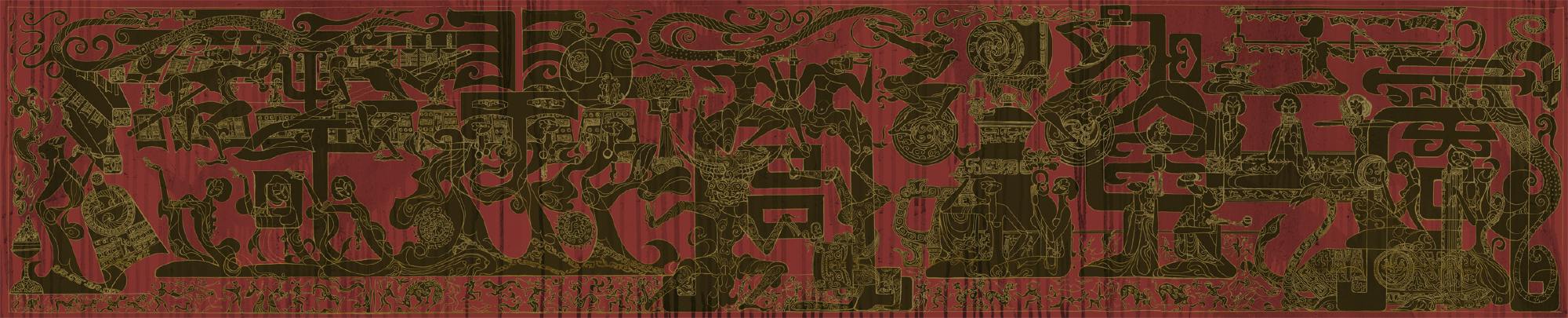
The mural seen at Mills was originally realized in 1981 as Music of the Great Earth, a 50 foot wide painting in the Foreign Students' Dining Hall at the Central Academy of Fine Arts in Beijing, where Liu received her graduate degree. In 1978, the artist had attended an exhibition in Beijing featuring centuries-old musical instruments unearthed in a recent excavation in the Hu Bei province. In a 2,400 year old tomb, archaeologists had discovered a 125-piece orchestra and 25 musicians. The ensemble of Chinese string, wind, and percussion instruments on display included a set of Bian Zhong bells (visible toward the left hand side of Liu's composition) ranging in size from eight inches to five feet tall; the set of bells is so enormous that players must stand and strike them with large mallets. Liu’s studies and drawings of the Hu Bei instruments became the basis for Music of the Great Earth.

In 1993, when Liu revisited China, she found that the former Dining Hall had been relegated to storage space; her mural, neglected for years, sat silently behind stacks of chairs and tables. In later years, Liu was told that it had finally been destroyed.

Hung Liu - Music of the Great Earth III, 2008.
Pigmented inkjet on paper, 18 x 90 in. Edition of 20

Liu used the large-scale printer at Magnolia Editions to create a new mural based on her earlier design, Music of the Great Earth II, which she further layered with hand-painted, autobiographical elements. She also printed a series of smaller Variations, which introduce new passages of color, texture, and figuration to her 1981 composition, on Hahnemuhle cotton rag paper at Magnolia Editions in 2008. Music...II and all of the Variations series are included in "Offerings."

We highly recommend experiencing this show by Liu, hailed as "America's most important Chinese artist" and one of our favorite people!

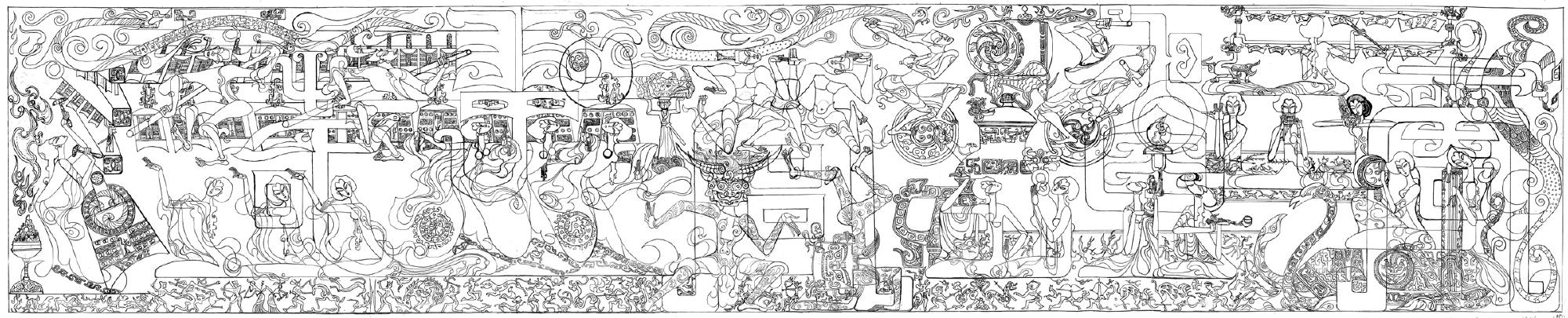
Hung Liu - Music of the Great Earth Line Drawing, 2008.
Pigmented inkjet on paper, 18 x 90 in. Edition of 20

Mills College Art Museum visiting hours and information

More art by Hung Liu from Magnolia Editions

Wednesday, February 6, 2013

Honoring David Kimball

David Kimball in the Magnolia Editions paper mill

Magnolia Editions co-founder David C. Kimball retires this year, after more than thirty years of sharing his expertise in the field of handmade paper with artists and artisans in the Bay Area community and beyond. 

A graduate of UCLA's Classics department with a Master's degree in Comparative Literature from San Francisco State, David entered the Ph. D. program in Comp Lit at the University of Oregon in the 1970s but was lured away by a young Bay Area papermaking enthusiast named Donald Farnsworth. Much like the 'patron saint of papermaking,' Dard Hunter, David's interest in paper grew out of his interest in books; initially, he recalls, he thought his experiments with paper might lead him to the field of letterpress printing or the production of literary broadsides.

Instead, he ended up co-founding Magnolia Editions in 1981 with Farnsworth and Arne Hiersoux, subsequently overseeing the studio's handmade paper mill as it relocated from its initial location in Kensington to the West Oakland warehouse location it occupies today. In the process, David became a behind-the-scenes collaborator on countless works of modern art. Many of Magnolia's early print editions either incorporated or were printed on handmade paper, such as Squeak Carnwath's Hand in Light lithograph series, which found Carnwath creating a unique effect by 'drawing' with raw paper pulp. Over the years, David created paper for editions by artists including Robert Arneson, Peter Voulkos, Joseph Goldyne, and Alan Magee; working with Farnsworth, he once used an eight-foot-long paper mold to create an enormous scroll of handmade paper for an ambitious print project by Judy Chicago


David Kimball gives a papermaking demonstration (video)

Magnolia has gained a reputation as a valuable source of papermaking supplies and knowledge, due in no small part to David's authority in the field. Recognized as a master papermaker, David has held demonstrations and classes for students and tour groups from all over the world at Magnolia's paper mill. Harlan Crowder's flickr features this photo set of a Magnolia Editions tour that includes several step-by-step shots of David demonstrating the papermaking process.

He has also hosted innovative programs such as the Combat Paper Project, which found Gulf War veterans recycling scraps of their combat uniforms into handmade paper. Meanwhile, he has been a valuable member of the handmade paper community at large, actively working to support the nonprofit magazine Hand Papermaking and at one point serving as its chairman of the board.

David Kimball and Robert Bechtle at Magnolia in 1982

David says the most rewarding part of his years at Magnolia has been the opportunity to create the substrate for a print or art piece -- to be a part of a team, serving a collaborator in the creation of a work of art. "It feels good," he says, "to know that I contributed even in a small way to, for example, Robert Bechtle's lithographs," popular editions on handmade paper which have long since sold out. He remains active in the handmade paper community and points to papermaker Timothy Barrett's recent MacArthur Fellowship as evidence of the medium's continued vitality. 

Kimball making paper at Magnolia in 2011

The staff at Magnolia Editions is proud and fortunate to have benefited from David Kimball's expertise, and we wish him the very best in his future endeavors.

Friday, February 1, 2013

Opening: Donald & Era Farnsworth at Red Barn Gallery

Bob Yogura is moved by 3-D prints by Donald and Era Farnsworth

Donald and Era Farnsworth's Specimens & Glass Houses recently opened at the Red Barn Gallery at the Pt. Reyes National Seashore Visitors Center in Pt. Reyes, California.

The glass houses of the exhibition's title refer to diatoms, single-cell organisms found in nearly every body of water on Earth that build delicate shells for themselves out of silica. Diatoms are major sources of oxygen in our atmosphere and are estimated to be responsible for 25% of the carbon fixation (conversion of carbon dioxide to organic compounds) in the ocean.

William Wiley with Donald and Era Farnsworth

By enlarging these microscopic life forms and rendering them using an eye-catching, stereoscopic 3-D process, the Farnsworths invite us to consider both the beauty and the ecological importance of these otherwise invisible creatures.

Mildred Howard, Margo Hackett, Bob Yogura and others enjoy the Farnsworth's 3-D prints

Specimens & Glass Houses runs from January 25 through April 1, 2013. Please visit the Pt. Reyes National Seashore website for visiting information.

William Wiley, Donald Farnsworth, and Hung Liu

Mary Webster with 3-D prints by the Farnsworths

Mary Webster, Barbi Anne Reed, William Wiley, Donald & Era Farnsworth (photo by Dallas Saunders)

Donald Farnsworth and Kevin Rowell with the irresistible Hung Liu (photo by Dallas Saunders)

More art by Donald & Era Farnsworth at Magnolia Editions