Friday, April 22, 2022
Enrique Chagoya & Don Farnsworth - "A Conversation on Books, Censorship, and Collaboration"
The YouTube video below includes a presentation by Enrique Chagoya about his artist's books and codices, followed by comments by Magnolia director Don Farnsworth and a Q&A session with both. Recorded on February 26, 2022 at the Legion of Honor, San Francisco, CA.


Public Art: Ranu Mukherjee at SFO Airport

Ranu Mukherjee - When the Path Through the Atmosphere is Longer, 2021
UV inkjet print, silk and cotton sari cloth, laminated glass and aluminum composite
Ranu Mukherjee's epic, eye-catching mixed-media work When the Path Through the Atmosphere is Longer was installed at SFO Airport's International Terminal G in February of this year.
"When the Path Through the Atmosphere is Longer is inspired by the feeling of being suspended in time and space during long-haul air travel and seeing two sunrises or sunsets in the same day. The image is collaged from printed sari cloth – a diasporic object that is rooted in Indian culture and suggests the movement of bodies. Included in the composition are depictions of the Arctic Tern, known for its long yearly migration, and the hummingbird, which is native to the Americas." (San Francisco Arts Commission)
Elements of this work were printed at Magnolia Editions in 2021; our neighbors Lenehan Architectural Glass also worked on the project.

Detail view of Ranu Mukherjee - When the Path Through the Atmosphere is Longer, 2021

Detail view of Ranu Mukherjee - When the Path Through the Atmosphere is Longer, 2021

Detail view of Ranu Mukherjee - When the Path Through the Atmosphere is Longer, 2021

Ranu Mukherjee with When the Path Through the Atmosphere is Longer, 2021 at SFO Airport
Friday, November 22, 2019
Artist interview: Hughen/Starkweather

acrylic and gold leaf on glass and aluminum, 7 x 26 ft, 2019
Hughen/Starkweather’s ongoing project Shifting Shorelines depicts and interprets the complex set of human and environmental factors that determine the ongoing history of shoreline areas. Artists Amanda Hughen and Jennifer Starkweather combine and distill a variety of visual and nonvisual data, including maps, photographs, topographies, interviews, and oral histories, into drawn, painted, and mixed-media imagery that mingles abstraction and representation to invite a fresh perspective on familiar landmarks and locations. The works in this series often combine passages of reticulated, washy “stains” made by wet or water-based media with areas of more hard-edged or linear marks, strategically summoning the idea of a shoreline landscape in the viewer’s mind.
Earlier this year, Hughen/Starkweather were selected via the SFMOMA to create a 7-foot-tall, 26-foot-long gold leaf and blue aluminum mural for the new Chase Center in San Francisco. Titled Between Water and Land and created at Magnolia Editions with assistance from Lenehan Glass in Oakland, this piece continues the themes of Shifting Shorelines, extending an abstracted gaze across the San Francisco Bay against a watery blue background.
The following conversation took place at Magnolia Editions on November 13, 2019 as Hughen/Starkweather began work on a large-scale commission for the Schwab corporate campus in Dallas, Texas. Writer Nick Stone spoke with the artists about the process of working at Magnolia to develop a site-specific work for the Chase Center lobby as well as their forthcoming Schwab commission, on which they continue to work closely with Magnolia Master Printer Tallulah Terryll.

NS: Your Shifting Shorelines project often uses imagery where water is part of the media, so you have this interaction between wet and dry not just metaphorically or conceptually but literally in the piece itself. Did water play any part in the composition of Between Water and Land for the Chase Center?
AH: It does. The piece is three layers. In the back you can see these stains; then in the next layer, these are actual maps.
JS: Images based on the original maps of the area.
AH: Maps of San Francisco, Oakland, Berkeley. So these stains are on the aluminum, the back-most panel, which includes areas of raw aluminum.
JS: We created the stains on paper separately and then blended and merged them into that all-over background so there’s a variety of water marks that are visible there – less visible in this piece than in other pieces that we’ve done.
AH: So you can see this the San Francisco Bay peninsula, then Berkeley, and then going east, basically to Stockton. When we first were invited to do the piece, I think they approached us because we do site-specific work frequently: we do work about places, we gather information, we do interviews with specialists and community members, we look at maps and photos. Mainly our work is about collapsing the past, present, and future of a place and then creating an abstraction that somehow speaks to that. So this is one of the most map-like pieces we’ve ever done. And one of the reasons we wanted to do that was that it’s in the main lobby which faces the San Francisco Bay, it sits right on the edge of the city, south of downtown, and it looks east. And so it’s right on the edge of the water, which used to be marsh and is now very industrial.
JS: So you see Mount Diablo, and you can imagine what goes beyond that too. And it’s such a distinct horizon line out there. We were interested in capturing that landscape, looking beyond.
AH: What did this very industrial shoreline right in front of us – what did that once look like, and what might it look like again? Because a lot of our work is about sea level rise. Could these natural areas, as we need to kind of abandon some of this developed area in order to allow the water – give it a place to go – some of these marshes are being brought back. And even things like fire – that is actually bringing back some of the wilderness area. So we were thinking a lot about, as Jennifer said, putting our arms around this larger Bay Area idea, of going all the way to Stockton. And also we knew that this [location within the Chase Center] was a long, skinny area, so it was kind of this perfect swath to go all the way to Stockton.
JS: And going back to your question about the use of wet media metaphorically and also as a subject or a concept, and less so in this piece, but I think the use of wet media also allows for lots of elements of chance to be brought into the work. That’s definitely an area that we don’t control; we definitely know more how to manipulate the wet media when we start, but it’s a way for us to bring in this surprise into the work, and sometimes it can create a structure or foundation for the work too.
It's like in addition to the two of you, the environment becomes another author of the piece, in a way.
AH: That’s a nice way to put it, definitely.

Can you tell me a little bit about the multiple layers you used in the fabrication of Between Water and Land and how you arrived at them?
JS: There’s three layers: a layer of aluminum, that Amanda spoke about, and that’s where the blue stain is. And then there’s two layers of glass that sit on top of that. We went through a range of ideas in terms of materials, but one of the reasons we settled on glass was it allowed for a sense of depth and space in an area that we imagined, when we first went in there, was fairly dark. And from the artist’s renderings that we saw, we weren’t really sure how that would work. That’s also really important to all of our work: we build layers on top of each other and here we tried to mimic that same kind of process. So on the different layers, there’s the aluminum; then there’s gold leaf, the yellow that’s printed on one layer – it had to have its own layer of glass, because it’s special. And then on another layer of glass is where all the pink is printed. And everything else is knocked-out white. It was a complicated project, wasn’t it?
AH: Oh my God. It really was!
JS: As you try to explain it, you realize – I mean, Amanda is the digital queen; just trying to wrap our head around what is printed, what is negative space, what is gold leaf –
AH: How do we break up the layers, what’s being scanned in... So the way it worked was, it was a commission from SFMOMA. And so we were working with SFMOMA and it was a very fast turnaround. We were notified of the commission in mid-April and it had to be done by mid-August. And that was basically a cold call. And so we very quickly developed ideas, some sketches, and they were interested in this idea. And then we started working with [Magnolia Editions] to figure out what is the best medium.
And we were concerned, as Jennifer said – it’s basically in an alcove, in the lobby. So there’s no direct light on it. It’s all glass, the space, so there’s a lot of natural light, but as you know, glass is reflective. So what we came up with was this idea of a dark background, with the silver of the aluminum popping with the map and then the gold really popping these areas off of that. Because our work can be super subtle, and we were concerned, knowing the space, knowing the lighting situation, knowing we had to go with glass –
JS: And there’s a lot going on in that space: there’s this big LED chandelier, and this kind of wood-veneered escalator wrap that goes around – so there’s a lot of different materials that are happening in this space. So we needed to create a piece that really stood out in this funny little alcove.
AH: So what we landed on was that the gold [represents] natural resources. So we basically did these drawings — this is sand dunes here, this is the Golden Gate Park Avenues/Richmond area of San Francisco, that was once all sand dunes. And so what we’ve done here is some of San Francisco – and this is true of the whole piece — are the actual city streets, but some of San Francisco and other parts of the map we’ve taken back to no development. These dots for us represent sand; so we’ve got these gold dots representing sand; we’ve got these topographies; marshlands, more sand. We were very deliberate and did a lot of research: what were these areas one point?
JS: And also looking at: how were sand dunes depicted in historical maps? What kind of symbols or marks did they use? And we referenced a lot of that.

AH: And again, this idea of compressing past, present, and future — so these are the airports: we put in the Oakland Airport and the San Francisco Airport. But then we just did them in dark blue. And people can kind of take what they want from that idea –
JS: Is it submerged? Or was it submerged?
Or will it be?
JS: Will it be, right.
AH: And so it was definitely a very ambitious project because the other thing we felt really strongly about was – thinking about the site, knowing all the people coming in from all over the Bay Area – again, Stockton is kind of this point of reference for us. We wanted people to be able to look at this map and say: there’s Stockton. And so we took the time to actually draw the streets of these towns, so people would be like: yup, there it is, and there’s Main Street. That was incredibly time-consuming as you can imagine. And that’s not something we’ve ever done before, to be that referential. But it felt important for this piece.
And then for the gold, as we said, it’s all these natural resources: mountain ranges; there’s a flock of birds somewhere; sand dunes, marshes, there’s some butterflies... and thinking of course about the symbolism of gold: the Golden State, this idea of the Gold Rush, the series of Gold Rushes that have hit the Bay Area – the tech Gold Rush, the [literal] Gold Rush. And thinking about natural resources now – with climate change and the incredible amount of development, and that possibly the most precious thing, the gold, you could say, of California is really becoming its natural resources. Because the resources dwindling and becoming more and more precious are really these wild areas, so that’s what we wanted to render in gold for this piece.
JS: And the pink lines, too – you know, ultimately we work very abstractly, even though we have references of a very depictive map in here. But for the pink lines, we wanted a reference to – it could be refracted light, the quality of light, it could be energy, a certain dynamism; so we wanted this other element in there to work with something that was more referential, like a map. And that’s where the pink lines came in. And there’s little references to topography in there. So it was more of an abstracted image that sat on top.

Tell me about Magnolia’s role in making Between Water and Land for the Chase Center and what it was like working here.
JS: Instrumental! I mean, we learned a lot from [Magnolia Editions Master Printer]Tallulah [Terryll], and this is the first time we’ve done anything at this scale and this complexity. And so they really guided us through this process a lot, everything from making the files to printing, giving us feedback about how to make the files, actually working on them... We’ll speak about Tallulah because that’s who we’ve worked with: she’s got such a fine sensibility and such a keen eye and she’s astute.
AH: And the knowledge of materials: for us, we mostly work on paper, so it’s about translating that to something that’s so incredibly different and trying to get our heads around how to do that, what’s it going to look like.
JS: The scale of it is huge; that’s something that we could not even imagine. And they’re used to blowing things up and envisioning what this looks like at a larger scale. That’s where it just takes more practice to start to understand that. And that’s where we really leaned on them. And you know, it is truly one of my favorite things to come in here and just see what they’re doing. It’s such a lab and they’re constantly experimenting, and they are always trying to reinvent something. And I think that’s super special and unique. I did a lot of research on other printers in the country, primarily in California, for other projects, and really no one does what they do.
AH: And it’s a mixture of understanding the materials and being willing to experiment and do things that maybe really haven’t been done before, but also a true respect for the artist. Tallulah would always come back to: well, what do you want? What is your vision of what this would look like? If we were tweaking little colors or a quality of line, that was a big thing. Because our work is so linear, so quality of line is really, really important to us. And Tallulah knows that because she’s looked at our work. So it was great to have that, that felt really good.
The other thing for me that was so critical is that we have complete trust that they have the artist as the most important player in this game. Because large-scale commissions, there are so many people involved – you’ve got the fabricator, the client, the installer, the framer, the engineer, the architect – and it just always felt like Magnolia had our back. This was actually a very complicated project with many players, and it was great to know that this is going to be the best piece it can be because Magnolia’s doing it with us.
JS: I’m going to add one last thing which is: they come from a tradition of printmaking, too. And I think that those roots of hands-on making are kind of the foundation here.

acrylic and gold leaf on glass and aluminum, 7 x 26 ft, 2019
I guess it speaks to your enthusiasm for working with Magnolia that you’re continuing to do so for another project. Can you tell me a little bit about the commission for the corporate campus in Dallas, Texas?
AH: So that’s different — we’re really excited to work on wood for that piece. So that’s going to be 28 feet wide by 18 feet high; it’s going to be 16 wood panels to create that size. And it’s in the new Schwab headquarters in Dallas, so it’s their largest headquarters outside of San Francisco. And they approached us, again with this idea of being interested in a site-specific work. So we went to Dallas: the site is off the beaten path, north of Fort Worth. We looked at the colors of the landscape, thought about the history of that landscape, the area – and what they wanted us to think about, too, was some kind of connection with San Francisco, which is why they invited a Bay Area artist to do this piece, I think. So we are creating an abstract, site-specific piece about that area...
JS: ...That Tallulah will be printing in the next few weeks.
AH: The way that it was constructed is different. The one that we’re doing for Dallas on wood is all one layer. So it’s one piece that’s scanned; [Between Water and Land] was more complicated because it actually had to be made up of different pieces to be scanned and then blown up. And then it was even more complicated because what we did was a gazillion tiny smaller drawings – so for example, we did a drawing of the tip of Marin; we did a drawing of Treasure Island; we did separate little drawings of the Presidio, of all of these marshes, and the airports; and each one of those was scanned in and then placed. So it was this crazy complicated digital file. So it was all handmade, but then [assembled] digitally.

acrylic and gold leaf on glass and aluminum, 7 x 26 ft, 2019
This is not specific to any one particular piece, but I was curious about your practice generally – one thing I read on your website and that I’m hearing now is that it’s informed by these visual and representational media like maps, but there’s also this component of interviewing people. I wondered: how does something that’s non-visual like that ultimately make its way into the artwork?
JS: It’s made its way in in a lot of different ways. In a more subtle way, it just informs us; and it broadens our understanding of our subject. We did a couple of projects around the construction of the new Bay Bridge a number of years ago, and we interviewed a lot of people for that project – from architects who were working on the bridge to Caltrans people, and that helped us understand the dimensionality of that project. In other pieces, we’ve taken actual excerpts and integrated them into the work; they become audio pieces that accompany the work; so we’ve played around with a lot of different ways where language or text can be a part of the actual piece.
AH: And our process is, as we said, about gathering information, and we talk a lot about how we are not specialists by any means in any of these places or topics that we make work about; we are very much learning and following this meandering trail of information. And that really interests us. And then this idea, for example, with the work we’re doing with climate change, thinking about: there’s so much data, so much information, a lot of it can be overwhelming; so how can our work kind of tap into this information in a way that goes beyond words or beyond data and allows the viewer to have a different kind of response to what’s going on? So it’s almost like we’re giving people space to think about a place or a topic in a different way than something like a newspaper article or a book or an interview would. So I feel like the interviews come into that process in a way that’s really unique, where sometimes we will directly solicit: can you talk about that place in visual terms? Can you tell us about it in descriptive terms? And then we will definitely think about those words when we’re making the work.
So it’s almost like they’re mapping it for you, but using language, instead of something more visual.
AH: Yes. And then, as Jennifer referred to, we’ve actually recently started to use text in the work itself, and so currently we’re working on a project that we’ll be showing in Miami in December where we’ve interviewed several people in Miami about the flooding that they are experiencing on a regular basis. We’ve been working on this project for almost exactly a year now. And we are interested in Miami because it’s a place in the United States that’s already experiencing flooding on a regular basis in a way that other coastal cities in the United States might experience soon. So we’ve been interviewing people from all over Miami, different backgrounds, different places in Miami about flooding, and we’re actually using some of that text in some of the pieces we’re creating. And it’s these text excerpts that are kind of abstracted. So there are words that can be made out, but it’s almost to give the viewer an idea of someone’s voice: there’s a voice here, there’s a person behind this.

for the Union Square/Market Street Station of San Francisco’s Central Subway.
Photo by Paul Chinn, The Chronicle
Hughen/Starkweather - artists' website
More public artworks created at Magnolia Editions
Friday, October 4, 2019
Kiki Smith "I Am a Wanderer" at Modern Art Oxford, London

"I Am a Wanderer," a retrospective exhibition of prints, sculptures, and tapestries by Kiki Smith, is currently on view at Modern Art Oxford in London.
The exhibition is curated by Petra Giloy-Hirtz and runs from September 28, 2019 through January 19, 2020.
Giloy-Hirtz writes:
In these works, a menagerie of real and mystical creatures, delicate plants and shooting stars are presented to us in an astonishing abundance of materials. Endlessly inventive, Smith has fashioned animal assortments in bronze, shells from gold, frogs from coloured glass, birds from beads, sea creatures from ink and flowers from precious silver. Exquisitely detailed etchings and drawings can also be seen alongside large-scale tapestries depicting empowered goddesses traveling through wild forests and starlit skies.
Magnolia Editions is the publisher of Kiki Smith's tapestries; to date, the artist has created twelve woven editions with Magnolia.
Please visit Magnolia's website to see more tapestries by Kiki Smith, or order the catalog Kiki Smith: Tapestries here.
For more information on the "I Am a Wanderer" exhibition including hours and admission details, please visit Modern Art Oxford.
Friday, August 30, 2019
Artist Interview: David Huffman
The following interview took place at Magnolia Editions on July 29, 2019 as David Huffman's new mixed-media work on panel Rise was in the final stages of fabrication. Rise was commissioned by SFMOMA on behalf of the Golden State Warriors for installation in the Warriors' new Chase Center in San Francisco; other artworks featured at the Chase Center include Alexander Calder’s mobile Untitled and Isamu Noguchi’s Play Sculpture, both on loan from SFMOMA, as well as an additional mural-sized commission from San Francisco artists Hughen/Starkweather (also fabricated by Magnolia Editions) and a sculpture by Olafur Eliasson located outside the arena.

The Chase Center in San Francisco (photo by Paul Chinn, The Chronicle)
Huffman's Rise is a 14-foot square abstract work that draws upon art-historical and urban vernacular forms, including basketball nets, handmade basketball stamps, and glitter. Nick Stone spoke with Huffman about the work's genesis, his artistic inspirations, and basketball greats from the Harlem Globetrotters and Dr. J to Lebron James and Stephen Curry:
NS: How did this commission come about for you?
DH: I got an email from Erin O’Toole, a curator at SFMOMA, and she asked me if I was interested in doing a commission for the Chase Center. It was very short notice: from beginning to end I think it was a four-month window, which is pretty tight. They were contacted by the Golden State Warriors asking about some artwork for the Chase Center: they wanted something of a high caliber, so they approached the Museum of Modern Art. Erin O’Toole, who’s a curator of photography at SFMOMA, had seen of my pieces in a group show at MoAD [Museum of the African Diaspora] and thought of me; she saw one of my net paintings, the mindset of the work, how I was dealing with basketball and since it was for the Warriors, thought: here’s somebody who’s already working with relevant iconography.

Detail from David Huffman's Rise; photo by Nick Stone
You’ve created a variety of artworks incorporating basketball imagery. When you got the commission, how did you end up selecting this particular composition?
Since recreating the piece would take a long time, we decided to take an existing piece and manipulate it; they didn’t know exactly how we would do it, but I researched and Magnolia was recommended very highly, and I looked at Magnolia’s website and saw some of the things the studio had done with other artists that I like. Then when I came in to the studio, I saw the Deborah Oropallo piece up here [Teardrop, 2015] and the Clare Rojas piece [a small print of Blue Deer on panel] and I saw how strong it looked: it looked like an original piece, not a printed reproduction, so I was really compelled by the quality. I thought, wow, it would be great if we could get one of the paintings to work that way. The tricky thing is that some of the work is so exact in scale that it might lose some of its quality when it’s blown up, so we had to think about that. And this piece — Double Jump — was the best when it came to scaling up. I used stamps to make these [basketball] patterns and I’ve recently created a stamp that is actually this size, so the enlargement has reached the scale of work that I’m already doing anyway. Also, this was a piece they were particularly interested in because it has both the chain hoop-net pattern and the nylon or cotton hoop netting, as well as the basketball shape itself. So this one had a certain quality that they thought would work well with the Chase Center and the whole ethos of basketball.
My concern is abstraction – color field painting and hard-edge abstraction – and social identity; I’m dealing with the language of the history of painting, reflecting on some of the moves that have already been made but also interjecting my own ideal in the social space that I felt was always left out of formalism in abstraction. So this was a merging of those two worlds. And Double Jump was one of my better, larger pieces; smaller ones might look a little more spread out when you enlarge them, to the point where you might lose the quality of the composition, whereas this one actually increased as it got bigger. And then when I started seeing these amazing samples that Magnolia was making, I got more confident about it and thought: this is a new piece. So I’m retitling the Chase Center piece Rise, as if this piece was born out of Double Jump. It was rising out, and in a certain way went slightly above the original painting, which was a little bit less saturated in color. The saturation increased, the scale increased — so the work will have a different relationship with the viewer’s body. The name Rise also came about because of the Warriors rising to the next stadium, and the game kind of takes place in the air now; there’s many attributes to the title.

David Huffman - Double Jump, 2014
Acrylic, oil, spray paint, glitter and printing ink on canvas, 69 x 69 in.
You’ve described basketball as a “black ballet that takes place in the air,” and there’s a weightlessness suggested by a lot of your work.
My priority as a painter is to reflect on the history of painting and to have a conversation with it, but also to inject my contemporary experiences — so that’s the social aspect of what I’m trying to do, to combine them. And they definitely look celestial in a way, because I’m what they call an Afrofuturist, so I love astronomy, sci-fi, I like things spacey. From my earlier works dealing specifically with outer space and astronauts and the whole space program, all of that is still there, even in abstraction — there’s a sort of “spaceness" to it, even though I’m not necessarily looking to achieve it.
There might be a link too between the physical excellence, the feats that you see on the basketball court, and the idea of “one small step for man, one giant step for mankind.”
It’s funny because I recently found Julius Erving [“Dr. J”] on Instagram, and he was the first player when I was growing up who put the game in the air. He would leap from the top of the key to dunk; no one was doing that. Everything was rudimentary — not to say there weren’t great players, of course there were; it’s just that he had put it in a different category, he literally raised it up.
Literally head and shoulders above everyone else.
Right. I had that poster, I’d stare at it in my room and I’d just look at this guy — he had lights below him! And the excellence, to use your term, in anything, it’s this type of unencumbered weightlessness of total freedom. Whatever it is, you hit that place where it ascends. And obviously the easiest way to think about it is physical ascension, flight, but literally that’s how creativity works. When it’s open, you lighten up; you get taken by it, as a subject.

David Huffman applies gesso to panels for Rise at Magnolia Editions; photo by Tallulah Terryll
Tell me about your connection to the Warriors. I know you grew up in Berkeley; were you always a Warriors fan?
Growing up in Berkeley, I was more of a baseball fan, actually; I was a big A’s person. Back when I was a kid, baseball was really the top thing, and basketball was around — but you just played basketball at the park because it was the fun thing to do. Most of my basketball experiences were just playing basketball outside with friends at the courts. But the Warriors were definitely champions. It was mostly Rick Berry: he was the most popular player on the Warriors when I was growing up. He had the weirdest shot. He would shoot underhand — it was the silliest thing. You almost thought, this is really bad skill; but he’d make it! And every kid started doing it. We all did it.
Sounds like something you’d see on the Washington Generals, the team that would play against the Harlem Globetrotters.
Right; it’s a silly thing. But you know, you mentioned the Harlem Globetrotters; they were more exciting to me than the actual game. I knew the Warriors and was definitely interested in them, but the Harlem Globetrotters were a much bigger influence. Because I would go and see them, and they would do all the magic. I mean, they did the hardest stuff I’ve ever seen.
And that’s the word, too: they brought magic to the game in a way that later players would do one at a time.
Well, if you look at it, they did stuff that they’re trying do in the NBA now. They’d do it in sections, as a show, but their feats were pretty high-level skill. But then there’d also be this vaudeville-esque type of performance that was about getting people interested. And you know, you’re not going to spin the ball on your finger all day long when you’re trying to make a shot in a real game. There’s just things that you do for entertainment, and then there are things like: what are the possibilities here when I go up for a layup? They really spread out the creativity map to say: there are various things that can happen on the court.
I would never have thought about it if you hadn’t brought it up, but the Harlem Globetrotters were really the deal. Curly was one of my favorite players. That ballet aspect — they really did it in an exceptional way. It was like they were superhuman. And the funny thing is, when we’d go there to see them, the crowd would be locked in such a way — it was like you were seeing something you couldn’t see anywhere else. You knew it was a unique moment. We were all mesmerized. And then I think later on, it turned into a thing that everyone expected. And I didn’t keep going as I got older — I got into real basketball. That’s when Julius Erving came in and changed the game and put it in the air. So you saw this excitement about this new kind of athleticism that the game started producing, and that Harlem Globetrotter thing got put to the side as a sort of circus. They’re still geniuses — but the NBA got more exciting. It’s almost like their energy went into the NBA and now you get these players doing really wild stuff.
The ballet part of it is this proficiency of the body, how it can be unencumbered by gravity, and the tradition of these moves. There’s a synergy in ballet of music and performance; if you just see the performance, it looks good, but it doesn’t have the same spice that music gives. When it’s tuned in with a certain piece of music, it becomes profound. It’s like John Coltrane taking “My Favorite Things” apart: a traditional tune, but brought back to you in this new way.

Detail from David Huffman's Rise; photo by Nick Stone
In terms of the combination of abstraction and more familiar iconography, you’re incorporating the basketballs, the nets; are there any other elements in this piece that are more consciously specific signifiers?
When I brought the chains in, I thought the chains were extremely apropos as a nod to the imprisonment and captivity of slavery, the idea that even though the shackles may have been physically removed, there are still emotional shackles. I remember when we would go to the park or were looking for a court, you would see a chain net and you’d just get depressed a little bit because it’s not what you want to play on: you want the cotton nets because they make a certain sound —
That satisfying “swish” sound.
Yes! But it also signified the durability and the kind of affordability — or lack thereof. Even those chain nets would be hanging off of three hooks, and kids would try to dunk and cut their hands all the time on them. They were this signifier of poverty, race, and location, a convergence of those things in a peripheral way. So it was important for me to add the chains along with the netting, because the netting, even though it was the ultimate material to play with, the chain was often the default.
The netting was aspirational, but the chain was what you had to work with.
The chain reflected the poverty of the situation in a certain way. So for me, the chains were a harsher signifier. As far as the stamping goes, it was also about recontextualizing form and camouflaging certain patterns into nods to hard-edge abstraction — so you would recognize it as a formal experience in painting, but then you’d see how these things were built by other forms. In traditional abstraction they would definitely aim for elements that didn’t signify anything outside the painting; the painting had its own dimension and priority that removed you from the world. And my take was, race and racism are also a type of abstraction — one that doesn’t get solved because it’s so abstract. So I thought, maybe abstract painting should include such things. It’s a way to have the definition in a subtle way: you lose its definition but gain pattern, and then after you understand the pattern, you might see the definition. So it’s a shape-shifting symbol, depending on how it’s being presented. There are also specific stamps where I put down the color and stamp the basketball on top of it, whereas with others, I’ve linked the negative spaces to create other qualities.
Some are discrete, and some become a field.
Yes, exactly. Because it’s kind of like I’m dealing with two different thoughts at the same time, which is really tricky to do.
So it becomes an elegant way to visually approach the idea of code-switching.
Formal elegance is extremely important, as a painter, for me. The priority again is the history of painting. So I’m after boundlessness there; but it has always emptied out the social experiences in a lot of ways, so it would just stay rudimentary in the sense of shapes and formal notions that really wouldn’t tell on who’s painting it or who the painting’s for. And I wanted to be specific: I’m an African-American person making these paintings, talking about abstraction, to have more of a contemporary twist on it.
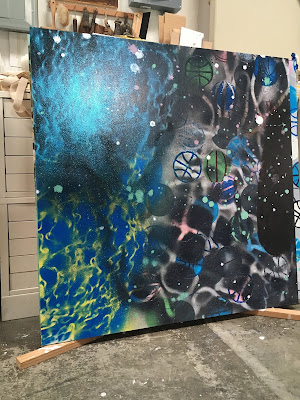
Individual panel from David Huffman's Rise at Magnolia Editions; photo by Tallulah Terryll
Is there spray paint in the original composition?
Yes, all this is spray paint. But when I talk about the chains and nets, I’m using real netting and real chains to create all the patternwork. The basketballs are handmade stamps but most of it is sprayed.
Spray paint has a kind of populist feeling to me; it’s a technique that almost everyone has access to, not one that I tend to associate with institutionally sanctioned artwork.
Exactly, it’s a default. It’s a weird discovery. I’ve used it in the past for different things but was always using it like a brush. So this was different. Everyone asks about the netting patterns — is it stenciling? No, it’s not. The difference between stenciling and what I do is that stenciling uses a block-out system that isn’t composed of whatever it is you’re trying to depict. Whereas I’m using the object itself. The term is aerography, which is an archaelogical term used to describe a cave painting technique, when you see the pigment blown through a hand to depict a hand on the wall. When you see the spray painted netting here, that’s exactly what that is; it happens to go way back. The only other time I’ve seen it is during the Surrealist period when Man Ray was doing that in photography. He did lots of real objects. And David Hammons did a beautiful piece of himself in a chair being strangled. So there are these moments where it is something basic that anyone can access, but it also goes back to the hand, which is super basic.
What can you tell me about your use of glitter?
I’ve used it a lot in the past, even before the abstract work, when I was doing more narrative work. I was after a sense of atmosphere. So I would put down a wash and then add the glitter, and the glitter would give a dimensional, atmospheric effect. There’d be angles where you don’t see any of the glitter — because I didn’t put a ton to where it would plate — there would just be enough to where it was embedded into the paint, so you saw it at an angle. I would only apply it with the paint; I never put it on top of a dry piece. It’s a layering, and it has to be organically settled through the drying process of the paint. So even if the paint is totally muddled and it breaks and the glitter settles into little rivers, that natural drying process is part of how it should look, too. So for me it’s about an atmospheric quality: how do I make this green “do” more green? Well, add some green glitter, so this essence of glitter is both flat and opaque, but also shimmers with light; it has a little bit more depth.
In Rise, the glitter is in the varnish on top?
Yes, but the original painting style, the glitter was in the washes. In this piece we can add it on top because it’s digitally printed; but it’s also being added with consideration to where the glitter was in the original painting. It’s not about adding glitter to an area that didn’t have it already; it’s just that the glitter didn’t show up in the photography of the original piece. So I’m looking for the mapping of it, and trying to follow it.

Detail from David Huffman's Rise; photo by Nick Stone
If a young person were looking at this work and trying to find some entry points into the history of painting, what might you suggest? Say someone came to you and asked, ‘David, who are you dialoguing with in this work…’? I see Twombly...
Of course, I’d be excited if a young person cared that much! (laughs) I’m also an instructor of painting, and my main emphasis in teaching is research. Everyone who’s interested in making a body of work that’s specific to what they care about has to develop their research skills. So you have to look at art not only aesthetically; you have to break it apart, how was it made, what are their intentions — there’s this research space where you gain access to more attributes that are otherwise unknown.
When it comes to one big artist that disrupted the space and performed colors that are unusual, I’d say Willem de Kooning is really important. He was kind of an illustrator when he first started making art, and he did very refined, tight line drawings. Then all of a sudden he started doing these super emotional, loose strokes — but somehow, those loose strokes are also deliberate. They’re just not the same look. I think what he’s done with painting in the sense of Abstract Expressionism — which is a term he probably wouldn’t care about; these terms are sort of thrown on a group of artists, but they all have their own take on it. Helen Frankenthaler is another person I would mention — these are people who have taken space and composition and sort of rebooted the conversation around them. The idea that Helen Frankenthaler would pick certain colors that were connected to her mindset. And de Kooning is in there, boxing with the boys that have always had control over the canon of painting; and she gets to have her own little thing that’s there, she’s doing it with them, but she also has her Other.
When it comes to some of the hard, conceptual components that I’m trying to inject into what I consider a monoculture of abstraction, people like Fred Wilson, Arthur Jafa; Kerry James Marshall — he’s not an abstract painter, but he’s done abstraction in an interesting way. People like Basquiat, too, when it comes to drawing, created a sense of freedom. I got to Cy Twombly through Basquiat. He went through Twombly, and got himself — I went through him, and got to Twombly (laughs). Drawing has always been extremely important to me, and Basquiat had this permission to just do it any way he wanted to. I’m sure there’s more —
But those are some fine names to start with! To wrap it up, who’s your favorite Warriors player currently?
Stephen Curry is it! The guy is underrated — he’s a genius, he’s humble, he’s powerful — every time I look he’s doing something trickier to break through. To make a quick comparison: Lebron gets the love; he can do things with ease, because he has all this support behind him. Someone like Curry, to me, doesn’t get that support; they’re always questioning him, waiting for him to not do it well — and he does it anyway. So I feel like he has a much tougher job with what he does than someone like Lebron. To me, Lebron is a crying baby whiner. Whereas Steph Curry is like, I’m just going to keep going —

Lebron James and Stephen Curry; photo by Ezra Shaw/Getty Images
Even if I have to work twice as hard for the same acclaim.
Exactly — and maybe I don’t get that acclaim, which is fine, because history will show that he can handle the ball so well. And at his height, too! His anatomy isn’t a tank coming down the middle; he has to be super sharp and fluid. I personally don’t think Kevin Durant should’ve even been on the team. It was top heavy! Here you’ve got a fantastic player and a team that just got its greatness going — and you push them around to fit a greater player in… The pillars of support before KD were already in place. When he came in they had to redo the architecture. Then when he got out of there, they have to redo the architecture again now. That’s why I don’t think they needed him. Anybody wants a great player, there’s nothing wrong with that, but I felt like: if he’s not going to stay there for the long run, it’s not healthy. I think Lebron has set a course on self-centeredness in playing that seems to be happening everywhere now. There’s no team loyalty. I grew up with team thinking; now—
Everybody’s a free agent.
The “teamness” of the game is really diminishing. And one thing I’ll say about the Warriors: they’ve got players that don’t want to leave that team. But I can’t say the same about any other team that’s successful. With all the adjustments and changes going on in the world, in technology and politics, I don’t want another unsettled space! So as much as I think Lebron is the greatest player — I do — I feel like there’s another part of his personality that has nothing to do with the game, it has to do with him. That’s not exciting. I like to think of a team – how they work together and get strong and produce greatness together. I don’t want to think about one player who wanders around doing whatever they feel like doing until they get a bunch of rings. That just doesn’t have the potency to me.
A friend of mine and I used to race slot cars. We’d have the fastest cars and the slowest cars. Everybody wants to race the fast cars: it’s more fun. And nobody wants to race the slow cars. Then we’d decide: let’s just race these slow, VW-style cars. They were really bad: they slid around... but if you were good at this, this was actually pretty great. It doesn’t have the speed, it doesn’t have the sense of control — you’d have to really feel it out. But we’d end up having way more fun with these slower cars, and it took way more skill to get them to work than the fast cars. So I think some of that quality, that nomadic, hot-dogness of a great player moving around is a similar thing: ‘I’m only going where I can get good stuff.’ Your greatness should be that you build your team! And that becomes magnificent. There’s something more glorious about that than waiting to hear who they’re going to pick.
That’s when a team really starts to Rise...!
David Huffman: artist's website
More information on the Chase Center's art commissions - SF Chronicle
Huffman's Rise is a 14-foot square abstract work that draws upon art-historical and urban vernacular forms, including basketball nets, handmade basketball stamps, and glitter. Nick Stone spoke with Huffman about the work's genesis, his artistic inspirations, and basketball greats from the Harlem Globetrotters and Dr. J to Lebron James and Stephen Curry:
NS: How did this commission come about for you?
DH: I got an email from Erin O’Toole, a curator at SFMOMA, and she asked me if I was interested in doing a commission for the Chase Center. It was very short notice: from beginning to end I think it was a four-month window, which is pretty tight. They were contacted by the Golden State Warriors asking about some artwork for the Chase Center: they wanted something of a high caliber, so they approached the Museum of Modern Art. Erin O’Toole, who’s a curator of photography at SFMOMA, had seen of my pieces in a group show at MoAD [Museum of the African Diaspora] and thought of me; she saw one of my net paintings, the mindset of the work, how I was dealing with basketball and since it was for the Warriors, thought: here’s somebody who’s already working with relevant iconography.

You’ve created a variety of artworks incorporating basketball imagery. When you got the commission, how did you end up selecting this particular composition?
Since recreating the piece would take a long time, we decided to take an existing piece and manipulate it; they didn’t know exactly how we would do it, but I researched and Magnolia was recommended very highly, and I looked at Magnolia’s website and saw some of the things the studio had done with other artists that I like. Then when I came in to the studio, I saw the Deborah Oropallo piece up here [Teardrop, 2015] and the Clare Rojas piece [a small print of Blue Deer on panel] and I saw how strong it looked: it looked like an original piece, not a printed reproduction, so I was really compelled by the quality. I thought, wow, it would be great if we could get one of the paintings to work that way. The tricky thing is that some of the work is so exact in scale that it might lose some of its quality when it’s blown up, so we had to think about that. And this piece — Double Jump — was the best when it came to scaling up. I used stamps to make these [basketball] patterns and I’ve recently created a stamp that is actually this size, so the enlargement has reached the scale of work that I’m already doing anyway. Also, this was a piece they were particularly interested in because it has both the chain hoop-net pattern and the nylon or cotton hoop netting, as well as the basketball shape itself. So this one had a certain quality that they thought would work well with the Chase Center and the whole ethos of basketball.
My concern is abstraction – color field painting and hard-edge abstraction – and social identity; I’m dealing with the language of the history of painting, reflecting on some of the moves that have already been made but also interjecting my own ideal in the social space that I felt was always left out of formalism in abstraction. So this was a merging of those two worlds. And Double Jump was one of my better, larger pieces; smaller ones might look a little more spread out when you enlarge them, to the point where you might lose the quality of the composition, whereas this one actually increased as it got bigger. And then when I started seeing these amazing samples that Magnolia was making, I got more confident about it and thought: this is a new piece. So I’m retitling the Chase Center piece Rise, as if this piece was born out of Double Jump. It was rising out, and in a certain way went slightly above the original painting, which was a little bit less saturated in color. The saturation increased, the scale increased — so the work will have a different relationship with the viewer’s body. The name Rise also came about because of the Warriors rising to the next stadium, and the game kind of takes place in the air now; there’s many attributes to the title.

Acrylic, oil, spray paint, glitter and printing ink on canvas, 69 x 69 in.
You’ve described basketball as a “black ballet that takes place in the air,” and there’s a weightlessness suggested by a lot of your work.
My priority as a painter is to reflect on the history of painting and to have a conversation with it, but also to inject my contemporary experiences — so that’s the social aspect of what I’m trying to do, to combine them. And they definitely look celestial in a way, because I’m what they call an Afrofuturist, so I love astronomy, sci-fi, I like things spacey. From my earlier works dealing specifically with outer space and astronauts and the whole space program, all of that is still there, even in abstraction — there’s a sort of “spaceness" to it, even though I’m not necessarily looking to achieve it.
There might be a link too between the physical excellence, the feats that you see on the basketball court, and the idea of “one small step for man, one giant step for mankind.”
It’s funny because I recently found Julius Erving [“Dr. J”] on Instagram, and he was the first player when I was growing up who put the game in the air. He would leap from the top of the key to dunk; no one was doing that. Everything was rudimentary — not to say there weren’t great players, of course there were; it’s just that he had put it in a different category, he literally raised it up.
Literally head and shoulders above everyone else.
Right. I had that poster, I’d stare at it in my room and I’d just look at this guy — he had lights below him! And the excellence, to use your term, in anything, it’s this type of unencumbered weightlessness of total freedom. Whatever it is, you hit that place where it ascends. And obviously the easiest way to think about it is physical ascension, flight, but literally that’s how creativity works. When it’s open, you lighten up; you get taken by it, as a subject.

Tell me about your connection to the Warriors. I know you grew up in Berkeley; were you always a Warriors fan?
Growing up in Berkeley, I was more of a baseball fan, actually; I was a big A’s person. Back when I was a kid, baseball was really the top thing, and basketball was around — but you just played basketball at the park because it was the fun thing to do. Most of my basketball experiences were just playing basketball outside with friends at the courts. But the Warriors were definitely champions. It was mostly Rick Berry: he was the most popular player on the Warriors when I was growing up. He had the weirdest shot. He would shoot underhand — it was the silliest thing. You almost thought, this is really bad skill; but he’d make it! And every kid started doing it. We all did it.
Sounds like something you’d see on the Washington Generals, the team that would play against the Harlem Globetrotters.
Right; it’s a silly thing. But you know, you mentioned the Harlem Globetrotters; they were more exciting to me than the actual game. I knew the Warriors and was definitely interested in them, but the Harlem Globetrotters were a much bigger influence. Because I would go and see them, and they would do all the magic. I mean, they did the hardest stuff I’ve ever seen.
And that’s the word, too: they brought magic to the game in a way that later players would do one at a time.
Well, if you look at it, they did stuff that they’re trying do in the NBA now. They’d do it in sections, as a show, but their feats were pretty high-level skill. But then there’d also be this vaudeville-esque type of performance that was about getting people interested. And you know, you’re not going to spin the ball on your finger all day long when you’re trying to make a shot in a real game. There’s just things that you do for entertainment, and then there are things like: what are the possibilities here when I go up for a layup? They really spread out the creativity map to say: there are various things that can happen on the court.
I would never have thought about it if you hadn’t brought it up, but the Harlem Globetrotters were really the deal. Curly was one of my favorite players. That ballet aspect — they really did it in an exceptional way. It was like they were superhuman. And the funny thing is, when we’d go there to see them, the crowd would be locked in such a way — it was like you were seeing something you couldn’t see anywhere else. You knew it was a unique moment. We were all mesmerized. And then I think later on, it turned into a thing that everyone expected. And I didn’t keep going as I got older — I got into real basketball. That’s when Julius Erving came in and changed the game and put it in the air. So you saw this excitement about this new kind of athleticism that the game started producing, and that Harlem Globetrotter thing got put to the side as a sort of circus. They’re still geniuses — but the NBA got more exciting. It’s almost like their energy went into the NBA and now you get these players doing really wild stuff.
The ballet part of it is this proficiency of the body, how it can be unencumbered by gravity, and the tradition of these moves. There’s a synergy in ballet of music and performance; if you just see the performance, it looks good, but it doesn’t have the same spice that music gives. When it’s tuned in with a certain piece of music, it becomes profound. It’s like John Coltrane taking “My Favorite Things” apart: a traditional tune, but brought back to you in this new way.

In terms of the combination of abstraction and more familiar iconography, you’re incorporating the basketballs, the nets; are there any other elements in this piece that are more consciously specific signifiers?
When I brought the chains in, I thought the chains were extremely apropos as a nod to the imprisonment and captivity of slavery, the idea that even though the shackles may have been physically removed, there are still emotional shackles. I remember when we would go to the park or were looking for a court, you would see a chain net and you’d just get depressed a little bit because it’s not what you want to play on: you want the cotton nets because they make a certain sound —
That satisfying “swish” sound.
Yes! But it also signified the durability and the kind of affordability — or lack thereof. Even those chain nets would be hanging off of three hooks, and kids would try to dunk and cut their hands all the time on them. They were this signifier of poverty, race, and location, a convergence of those things in a peripheral way. So it was important for me to add the chains along with the netting, because the netting, even though it was the ultimate material to play with, the chain was often the default.
The netting was aspirational, but the chain was what you had to work with.
The chain reflected the poverty of the situation in a certain way. So for me, the chains were a harsher signifier. As far as the stamping goes, it was also about recontextualizing form and camouflaging certain patterns into nods to hard-edge abstraction — so you would recognize it as a formal experience in painting, but then you’d see how these things were built by other forms. In traditional abstraction they would definitely aim for elements that didn’t signify anything outside the painting; the painting had its own dimension and priority that removed you from the world. And my take was, race and racism are also a type of abstraction — one that doesn’t get solved because it’s so abstract. So I thought, maybe abstract painting should include such things. It’s a way to have the definition in a subtle way: you lose its definition but gain pattern, and then after you understand the pattern, you might see the definition. So it’s a shape-shifting symbol, depending on how it’s being presented. There are also specific stamps where I put down the color and stamp the basketball on top of it, whereas with others, I’ve linked the negative spaces to create other qualities.
Some are discrete, and some become a field.
Yes, exactly. Because it’s kind of like I’m dealing with two different thoughts at the same time, which is really tricky to do.
So it becomes an elegant way to visually approach the idea of code-switching.
Formal elegance is extremely important, as a painter, for me. The priority again is the history of painting. So I’m after boundlessness there; but it has always emptied out the social experiences in a lot of ways, so it would just stay rudimentary in the sense of shapes and formal notions that really wouldn’t tell on who’s painting it or who the painting’s for. And I wanted to be specific: I’m an African-American person making these paintings, talking about abstraction, to have more of a contemporary twist on it.

Is there spray paint in the original composition?
Yes, all this is spray paint. But when I talk about the chains and nets, I’m using real netting and real chains to create all the patternwork. The basketballs are handmade stamps but most of it is sprayed.
Spray paint has a kind of populist feeling to me; it’s a technique that almost everyone has access to, not one that I tend to associate with institutionally sanctioned artwork.
Exactly, it’s a default. It’s a weird discovery. I’ve used it in the past for different things but was always using it like a brush. So this was different. Everyone asks about the netting patterns — is it stenciling? No, it’s not. The difference between stenciling and what I do is that stenciling uses a block-out system that isn’t composed of whatever it is you’re trying to depict. Whereas I’m using the object itself. The term is aerography, which is an archaelogical term used to describe a cave painting technique, when you see the pigment blown through a hand to depict a hand on the wall. When you see the spray painted netting here, that’s exactly what that is; it happens to go way back. The only other time I’ve seen it is during the Surrealist period when Man Ray was doing that in photography. He did lots of real objects. And David Hammons did a beautiful piece of himself in a chair being strangled. So there are these moments where it is something basic that anyone can access, but it also goes back to the hand, which is super basic.
What can you tell me about your use of glitter?
I’ve used it a lot in the past, even before the abstract work, when I was doing more narrative work. I was after a sense of atmosphere. So I would put down a wash and then add the glitter, and the glitter would give a dimensional, atmospheric effect. There’d be angles where you don’t see any of the glitter — because I didn’t put a ton to where it would plate — there would just be enough to where it was embedded into the paint, so you saw it at an angle. I would only apply it with the paint; I never put it on top of a dry piece. It’s a layering, and it has to be organically settled through the drying process of the paint. So even if the paint is totally muddled and it breaks and the glitter settles into little rivers, that natural drying process is part of how it should look, too. So for me it’s about an atmospheric quality: how do I make this green “do” more green? Well, add some green glitter, so this essence of glitter is both flat and opaque, but also shimmers with light; it has a little bit more depth.
In Rise, the glitter is in the varnish on top?
Yes, but the original painting style, the glitter was in the washes. In this piece we can add it on top because it’s digitally printed; but it’s also being added with consideration to where the glitter was in the original painting. It’s not about adding glitter to an area that didn’t have it already; it’s just that the glitter didn’t show up in the photography of the original piece. So I’m looking for the mapping of it, and trying to follow it.

If a young person were looking at this work and trying to find some entry points into the history of painting, what might you suggest? Say someone came to you and asked, ‘David, who are you dialoguing with in this work…’? I see Twombly...
Of course, I’d be excited if a young person cared that much! (laughs) I’m also an instructor of painting, and my main emphasis in teaching is research. Everyone who’s interested in making a body of work that’s specific to what they care about has to develop their research skills. So you have to look at art not only aesthetically; you have to break it apart, how was it made, what are their intentions — there’s this research space where you gain access to more attributes that are otherwise unknown.
When it comes to one big artist that disrupted the space and performed colors that are unusual, I’d say Willem de Kooning is really important. He was kind of an illustrator when he first started making art, and he did very refined, tight line drawings. Then all of a sudden he started doing these super emotional, loose strokes — but somehow, those loose strokes are also deliberate. They’re just not the same look. I think what he’s done with painting in the sense of Abstract Expressionism — which is a term he probably wouldn’t care about; these terms are sort of thrown on a group of artists, but they all have their own take on it. Helen Frankenthaler is another person I would mention — these are people who have taken space and composition and sort of rebooted the conversation around them. The idea that Helen Frankenthaler would pick certain colors that were connected to her mindset. And de Kooning is in there, boxing with the boys that have always had control over the canon of painting; and she gets to have her own little thing that’s there, she’s doing it with them, but she also has her Other.
When it comes to some of the hard, conceptual components that I’m trying to inject into what I consider a monoculture of abstraction, people like Fred Wilson, Arthur Jafa; Kerry James Marshall — he’s not an abstract painter, but he’s done abstraction in an interesting way. People like Basquiat, too, when it comes to drawing, created a sense of freedom. I got to Cy Twombly through Basquiat. He went through Twombly, and got himself — I went through him, and got to Twombly (laughs). Drawing has always been extremely important to me, and Basquiat had this permission to just do it any way he wanted to. I’m sure there’s more —
But those are some fine names to start with! To wrap it up, who’s your favorite Warriors player currently?
Stephen Curry is it! The guy is underrated — he’s a genius, he’s humble, he’s powerful — every time I look he’s doing something trickier to break through. To make a quick comparison: Lebron gets the love; he can do things with ease, because he has all this support behind him. Someone like Curry, to me, doesn’t get that support; they’re always questioning him, waiting for him to not do it well — and he does it anyway. So I feel like he has a much tougher job with what he does than someone like Lebron. To me, Lebron is a crying baby whiner. Whereas Steph Curry is like, I’m just going to keep going —

Even if I have to work twice as hard for the same acclaim.
Exactly — and maybe I don’t get that acclaim, which is fine, because history will show that he can handle the ball so well. And at his height, too! His anatomy isn’t a tank coming down the middle; he has to be super sharp and fluid. I personally don’t think Kevin Durant should’ve even been on the team. It was top heavy! Here you’ve got a fantastic player and a team that just got its greatness going — and you push them around to fit a greater player in… The pillars of support before KD were already in place. When he came in they had to redo the architecture. Then when he got out of there, they have to redo the architecture again now. That’s why I don’t think they needed him. Anybody wants a great player, there’s nothing wrong with that, but I felt like: if he’s not going to stay there for the long run, it’s not healthy. I think Lebron has set a course on self-centeredness in playing that seems to be happening everywhere now. There’s no team loyalty. I grew up with team thinking; now—
Everybody’s a free agent.
The “teamness” of the game is really diminishing. And one thing I’ll say about the Warriors: they’ve got players that don’t want to leave that team. But I can’t say the same about any other team that’s successful. With all the adjustments and changes going on in the world, in technology and politics, I don’t want another unsettled space! So as much as I think Lebron is the greatest player — I do — I feel like there’s another part of his personality that has nothing to do with the game, it has to do with him. That’s not exciting. I like to think of a team – how they work together and get strong and produce greatness together. I don’t want to think about one player who wanders around doing whatever they feel like doing until they get a bunch of rings. That just doesn’t have the potency to me.
A friend of mine and I used to race slot cars. We’d have the fastest cars and the slowest cars. Everybody wants to race the fast cars: it’s more fun. And nobody wants to race the slow cars. Then we’d decide: let’s just race these slow, VW-style cars. They were really bad: they slid around... but if you were good at this, this was actually pretty great. It doesn’t have the speed, it doesn’t have the sense of control — you’d have to really feel it out. But we’d end up having way more fun with these slower cars, and it took way more skill to get them to work than the fast cars. So I think some of that quality, that nomadic, hot-dogness of a great player moving around is a similar thing: ‘I’m only going where I can get good stuff.’ Your greatness should be that you build your team! And that becomes magnificent. There’s something more glorious about that than waiting to hear who they’re going to pick.
That’s when a team really starts to Rise...!
David Huffman: artist's website
More information on the Chase Center's art commissions - SF Chronicle
Tuesday, January 29, 2019
Work in progress: Alexandre Arrechea handmade paper pieces

Work continues in Magnolia's paper studio this week on a series of handmade paper works by Alexandre Arrechea.


The artist has devised a unique composition strategy for creating his trademark mask shapes, comprised of photographic imagery of the corners of Cuban buildings, using handmade paper created at Magnolia Editions' paper studio.

Handmade paper is formed in large custom shapes which are printed using UV acrylic ink and then 'floated' together within a frame to create a composite, collaged image with an unusual degree of dimensionality.


The results of Arrechea's experiments with Magnolia, as well as a survey of the artist's mask works, will be exhibited at Galeria Nara Roesler in New York City (opening February 20, 2019) and at New York City's Armory Show at Piers 92 & 94 in March.
Also check out the artist's colorful Instagram account for previews!
More art by Alex Arrechea from Magnolia Editions
Thursday, January 10, 2019
Artist Interview: Alexandre Arrechea

Jacquard tapestry
99 x 99 in. Edition of 3
Trinidad-born, New York-based artist Alexandre Arrechea’s work explores the intersection of art and society, taking particular delight in confounding the questions of form and function posed by architecture. He was a founding member of the storied Cuban artist’s collective Los Carpinteros, responsible for some of the most important drawings and installations to emerge from Latin America in the last twenty years. Arrechea's work in media including sculpture, video, and installation continues to deconstruct and re-envision the visual syntax of architecture and the environment with humor and élan.


Arrechea has worked closely with Magnolia Editions since 2015. His first tapestry edition Mask Series: Havana (2016) weaves together a vibrant photomontage, one of a series of masks whose constituent elements are drawn from photographs of buildings in the Cuban capital. Specifically, Arrechea strategically photographs the corners of these buildings such that the light (sunny) and dark (shadow) sides are both visible, yielding two distinct tonalities. The resulting imagery possesses a curious and provocative mixture of flatness and depth, familiarity and exoticism, abstraction and mimesis.

Jacquard tapestry
72 x 70 in. Edition of 3
In addition to his ongoing series of tapestries, Arrechea has been working with Donald Farnsworth and Tallulah Terryll in Magnolia's handmade paper studio, exploring the possibilities of translating his mask compositions by deploying handmade paper in a variety of novel ways – e.g., printing, embossing, or composing an image via sections comprised of pulps of various tonalities.
The results of Arrechea's experiments with Magnolia, as well as a survey of the artist's mask works, will be exhibited at Galeria Nara Roesler in New York City (opening February 20, 2019) and at New York City's Armory Show at Piers 92 & 94 in March. (Check out the artist's colorful Instagram account for previews!)

Jacquard tapestry
72 x 70 in. Edition of 3
Writer Nick Stone caught up with Arrechea at Magnolia Editions recently for a brief chat about his ongoing collaboration with the studio:
NS: How did you first get involved with Magnolia Editions?
AA: I remember being in New York in 2014. At the time I was already working on the idea of the masks; I had printed them on regular photo paper and framed them conventionally. I exhibited them at my studio in Havana. I was happy with the results, but I felt something was missing, something was lacking there. I still needed to find the right medium for those particular pieces.
In New York I’m walking in Chelsea and I enter Pace Gallery and see Chuck Close’s show of tapestries at Pace. I’m looking at them and thinking, wow, this is all I need! This is the medium I need in particular for developing these ideas. So I spoke a friend to see if he knew who did the fabrication for Chuck and he said, yes, I know someone who can introduce you to them.
In 2015 that friend of mine and I decided to come to the west coast because we wanted to plan a visit to Napa Valley. Because Magnolia is here in Oakland I said, this is perfect, we can visit them. So that’s the moment when we came to Magnolia and had a really nice chat about the possibility of working together.

with Arrechea's 2016 tapestry Mask Series: Havana; photo by Nick Stone
Departing from there, I did exhibit my first tapestry in the Havana Biennale in 2015. It was interesting because at the time I exhibited that particular piece alongside other installations I did in the national museum in Cuba and people didn’t connect immediately with the work; they didn’t know exactly what it was. Especially because of the nature of the work itself. When you have to explain that those [constituent elements] are corners, that it’s a tapestry... nobody was familiar with that language in Cuba at the time. I remember there was this collector from London, he came to the exhibition, saw the piece and fell in love with the piece immediately.
I continued my exchange with Don and Era about the possibilities of this collaboration and there was a moment where Don told me: “Alex, you don’t have to worry about producing [fabricating] this; we can help you to organize all that so you can focus on creating the ideas.” So that definitely put the work on a different level.

I had been absent from the workshop for a period, because we had done this first project in 2015 and I haven’t visited Magnolia again until now. But we have been collaborating from afar. It became so natural for me to discuss ideas with Don and Era and Nicholas [Price] that right now it feels like this collaboration is growing and growing. And I’ve been feeding my gallery with information about what we’re doing now and everyone is so excited.
So now we are doing for the first time the first show dedicated to the masks, in February, so this is very exciting. And we are planning another show in June in Brazil, in Rio de Janeiro, to which I’m also going to bring all of the ideas we have been ruminating about during my time here.


NS: You’ve worked with various collaborators and fabricators over the years. What stands out to you as being unique about working with Magnolia? How would you describe it to another artist?
AA: One of the things that I fell in love with about this place since the first visit is the curiosity that Don showed me about investigating materials, process, and recognizing history as part of the ground that makes this place possible. In that sense I think we have a familiarity; for me that was a perfect approach. Then on top of that you have this moment in which you are discussing an idea and then Don brings you something that he was thinking about the ideas that you’d brought that takes your ideas to a different level.
So this discussion has become so rich and so perfect to me that at this moment I consider this place, Magnolia Editions, one of my main places to bring experiments – future experiments that you still don’t know [how it will turn out]. For instance, when I arrived here this week, Don showed me some tests he had done using paper, and I said to Don: “Were you visiting my head the week before, or what?” Because I had been thinking precisely of that. It’s funny, this idea of creating the paper by pouring different colors of pulp in certain areas and creating one sheet of paper formed with different tonalities – that is something that I was trying to build up but I didn’t know how. And then arriving here, Don had that ready for me and it’s like: come on, you’ve got to be kidding me.


NS: So it looks like you and Don are working on masks at various different scales and in a few different media?
AA: Yes, we started with the tapestries — first eight feet tall, then six feet tall. Then we started with handmade paper, first printing just on the surface so that the texture of the paper blends with the texture of the image. Then came this new opportunity, which I realized was interesting, to separate the layers. Now we are in this third or fourth part of the process which is mixing those two ideas: using paper that is already multiple tonalities, and then placing the layers on top of it. So it’s getting richer and richer.


More art by Alex Arrechea from Magnolia Editions
Alexandre Arrechea - artist's website
Subscribe to:
Posts (Atom)