Showing posts with label handmade paper. Show all posts

Tuesday, January 29, 2019

Work in progress: Alexandre Arrechea handmade paper pieces

Handmade paper components for forthcoming work by Alex Arrechea

Work continues in Magnolia's paper studio this week on a series of handmade paper works by Alexandre Arrechea.

Handmade paper components for forthcoming work by Alex Arrechea

Handmade paper components for forthcoming work by Alex Arrechea

The artist has devised a unique composition strategy for creating his trademark mask shapes, comprised of photographic imagery of the corners of Cuban buildings, using handmade paper created at Magnolia Editions' paper studio.

Handmade paper components for forthcoming work by Alex Arrechea

Handmade paper is formed in large custom shapes which are printed using UV acrylic ink and then 'floated' together within a frame to create a composite, collaged image with an unusual degree of dimensionality.

Handmade paper components for forthcoming work by Alex Arrechea

Snapshot of a completed Arrechea work, showing the layered "floating" collage approach

The results of Arrechea's experiments with Magnolia, as well as a survey of the artist's mask works, will be exhibited at Galeria Nara Roesler in New York City (opening February 20, 2019) and at New York City's Armory Show at Piers 92 & 94 in March.

Also check out the artist's colorful Instagram account for previews!


More art by Alex Arrechea from Magnolia Editions


Thursday, January 10, 2019

Artist Interview: Alexandre Arrechea

Alexandre Arrechea - Mask Series: Havana, 2016
Jacquard tapestry
99 x 99 in. Edition of 3


Trinidad-born, New York-based artist Alexandre Arrechea’s work explores the intersection of art and society, taking particular delight in confounding the questions of form and function posed by architecture. He was a founding member of the storied Cuban artist’s collective Los Carpinteros, responsible for some of the most important drawings and installations to emerge from Latin America in the last twenty years. Arrechea's work in media including sculpture, video, and installation continues to deconstruct and re-envision the visual syntax of architecture and the environment with humor and élan.


Arrechea has worked closely with Magnolia Editions since 2015. His first tapestry edition Mask Series: Havana (2016) weaves together a vibrant photomontage, one of a series of masks whose constituent elements are drawn from photographs of buildings in the Cuban capital. Specifically, Arrechea strategically photographs the corners of these buildings such that the light (sunny) and dark (shadow) sides are both visible, yielding two distinct tonalities. The resulting imagery possesses a curious and provocative mixture of flatness and depth, familiarity and exoticism, abstraction and mimesis.

Alexandre Arrechea - Black Eye in Vedado, 2018
Jacquard tapestry
72 x 70 in. Edition of 3


In addition to his ongoing series of tapestries, Arrechea has been working with Donald Farnsworth and Tallulah Terryll in Magnolia's handmade paper studio, exploring the possibilities of translating his mask compositions by deploying handmade paper in a variety of novel ways – e.g., printing, embossing, or composing an image via sections comprised of pulps of various tonalities.

The results of Arrechea's experiments with Magnolia, as well as a survey of the artist's mask works, will be exhibited at Galeria Nara Roesler in New York City (opening February 20, 2019) and at New York City's Armory Show at Piers 92 & 94 in March. (Check out the artist's colorful Instagram account for previews!)

Alexandre Arrechea - Confusion in Centro Havana, 2018
Jacquard tapestry
72 x 70 in. Edition of 3


Writer Nick Stone caught up with Arrechea at Magnolia Editions recently for a brief chat about his ongoing collaboration with the studio:

NS: How did you first get involved with Magnolia Editions?

AA: I remember being in New York in 2014. At the time I was already working on the idea of the masks; I had printed them on regular photo paper and framed them conventionally. I exhibited them at my studio in Havana. I was happy with the results, but I felt something was missing, something was lacking there. I still needed to find the right medium for those particular pieces.

In New York I’m walking in Chelsea and I enter Pace Gallery and see Chuck Close’s show of tapestries at Pace. I’m looking at them and thinking, wow, this is all I need! This is the medium I need in particular for developing these ideas. So I spoke a friend to see if he knew who did the fabrication for Chuck and he said, yes, I know someone who can introduce you to them.

In 2015 that friend of mine and I decided to come to the west coast because we wanted to plan a visit to Napa Valley. Because Magnolia is here in Oakland I said, this is perfect, we can visit them. So that’s the moment when we came to Magnolia and had a really nice chat about the possibility of working together.

Donald Farnsworth and Alexandre Arrechea at Magnolia Editions
with Arrechea's 2016 tapestry Mask Series: Havana; photo by Nick Stone


Departing from there, I did exhibit my first tapestry in the Havana Biennale in 2015. It was interesting because at the time I exhibited that particular piece alongside other installations I did in the national museum in Cuba and people didn’t connect immediately with the work; they didn’t know exactly what it was. Especially because of the nature of the work itself. When you have to explain that those [constituent elements] are corners, that it’s a tapestry... nobody was familiar with that language in Cuba at the time. I remember there was this collector from London, he came to the exhibition, saw the piece and fell in love with the piece immediately.

I continued my exchange with Don and Era about the possibilities of this collaboration and there was a moment where Don told me: “Alex, you don’t have to worry about producing [fabricating] this; we can help you to organize all that so you can focus on creating the ideas.” So that definitely put the work on a different level.


I had been absent from the workshop for a period, because we had done this first project in 2015 and I haven’t visited Magnolia again until now. But we have been collaborating from afar. It became so natural for me to discuss ideas with Don and Era and Nicholas [Price] that right now it feels like this collaboration is growing and growing. And I’ve been feeding my gallery with information about what we’re doing now and everyone is so excited.

So now we are doing for the first time the first show dedicated to the masks, in February, so this is very exciting. And we are planning another show in June in Brazil, in Rio de Janeiro, to which I’m also going to bring all of the ideas we have been ruminating about during my time here.


NS: You’ve worked with various collaborators and fabricators over the years. What stands out to you as being unique about working with Magnolia? How would you describe it to another artist?

AA: One of the things that I fell in love with about this place since the first visit is the curiosity that Don showed me about investigating materials, process, and recognizing history as part of the ground that makes this place possible. In that sense I think we have a familiarity; for me that was a perfect approach. Then on top of that you have this moment in which you are discussing an idea and then Don brings you something that he was thinking about the ideas that you’d brought that takes your ideas to a different level.

So this discussion has become so rich and so perfect to me that at this moment I consider this place, Magnolia Editions, one of my main places to bring experiments – future experiments that you still don’t know [how it will turn out]. For instance, when I arrived here this week, Don showed me some tests he had done using paper, and I said to Don: “Were you visiting my head the week before, or what?” Because I had been thinking precisely of that. It’s funny, this idea of creating the paper by pouring different colors of pulp in certain areas and creating one sheet of paper formed with different tonalities – that is something that I was trying to build up but I didn’t know how. And then arriving here, Don had that ready for me and it’s like: come on, you’ve got to be kidding me.


NS: So it looks like you and Don are working on masks at various different scales and in a few different media?

AA: Yes, we started with the tapestries — first eight feet tall, then six feet tall. Then we started with handmade paper, first printing just on the surface so that the texture of the paper blends with the texture of the image. Then came this new opportunity, which I realized was interesting, to separate the layers. Now we are in this third or fourth part of the process which is mixing those two ideas: using paper that is already multiple tonalities, and then placing the layers on top of it. So it’s getting richer and richer.


More art by Alex Arrechea from Magnolia Editions

Alexandre Arrechea - artist's website

Tuesday, May 29, 2018

Open Studios June 2 and 3: Handmade paper sale!

Find handmade paper at an exceptional bargain this weekend at Magnolia's open studios.

Artists, art lovers, collectors, and handmade paper enthusiasts alike are invited to visit Magnolia's Open Studios this weekend, June 2 and 3, from 10 am to 4 pm.

The studio will offer a print sale during Open Studios this year. Such sales only happen at the studio once or twice a decade... Many brilliant editions from the archives will be available at a discount!

Various sizes, colors, and quantities of handmade paper will also be available at unprecedented prices -- in many cases, lower than what you might pay wholesale.

Please join us at 2527 Magnolia St in Oakland, CA (Google maps link).

(Please note: sale applies only to framed work and selected editions. Sale prices available only to Open Studios visitors in person; sorry, no sale prices via web/phone.)

Friday, July 29, 2016

Congratulations Chris Fraser, Awagami Artist in Residence 2016

Artist Chris Fraser with recent work; photos courtesy Fraser and Gallery Wendi Norris.

Congratulations to our friend and Magnolia Street neighbor Chris Fraser, who is currently in Tokushima, Japan for the 2016 Artist in Residency program at Awagami Paper Factory.

Fraser is represented by Gallery Wendi Norris. You may recall Awagami as the family-run handmade paper mill responsible for the giant (55.5 x 44 in!) sheets of handmade paper used in Chuck Close's 2014 watercolor edition Phil. Magnolia is pleased to continue its relationship with this historic yet innovative company, and to see them partner with the talented Fraser to create exciting new works involving handmade paper.

Congratulations, Chris!

Chris Fraser studio website

Awagami Paper Factory website

Monday, August 25, 2014

Japanese Papermaking class in October

Custom watermark moulds fabricated using Magnolia's 3-D printer

On October 4th, Carol Brighton’s popular Japanese Papermaking class returns to our recently renovated paper studio! Please reserve your spot by emailing papermagnolia@hotmail.com, and don't hesitate to pass this info on to anyone you know who might be curious about how paper is made.
  • Japanese Papermaking with instructor Carol Brighton will meet on Saturday, Oct. 4 from 10 am to 4 pm:
    Japanese paper (washi) is world famous for its beauty and strength. Learn to make traditional washi step-by-step from cooking and beating the fibers to sheet formation and drying. We will make sheets on sugetas (Japanese moulds) and Western style moulds, learn to laminate inclusions in collage, and explore other techniques for decorative papers. Students are encouraged to bring items to use as inclusions such as dried flowers, lace, fabric, or printed papers that will not bleed when wet.

    Instructor Carol Brighton is an artist whose handmade paper expertise is evident in her printmaking and pulp paintings. Her latest paper works, many made during a recent visit to the Awagami Factory in Japan, can be seen in an upcoming exhibition at the UC Faculty club in September. Brighton recently retired from teaching papermaking at the Academy of Art and now conducts private workshops at Magnolia and in her own studio.
Photo by Michelle Wilson from her most recent papermaking workshop in Magnolia Editions

Classes will be limited to 8 participants each, so early reservations are recommended. Your place will be considered reserved once we have received your payment.

The fee for each workshop is $160 per person; materials will be provided at no additional cost. Each participant will also receive a free copy of Donald Farnsworth’s book A Guide To Japanese Papermaking (while supplies last).


(A note on cancelled reservations: cancellations will be refunded in full if made at least three days before the class, or if we can fill your spot. Cancellations occuring within three days before class that cannot be filled will be given a 25% refund.)
Again, to reserve a place in these workshops, please email papermagnolia@hotmail.com.

Handmade paper with custom Magnolia watermark

Monday, April 28, 2014

Works on handmade paper from Awagami Factory

Extra large sheets of washi being made at Awagami Factory in Tokushima, Japan for Chuck Close prints at Magnolia Editions; photos by Craig Anczelowitz

Proof of a watercolor print by Chuck Close on custom-made Awagami handmade paper

Detail of proof by Chuck Close on Awagami handmade paper

Recently, Magnolia received a generous offer from the Awagami Factory in Tokushima, Japan. Magnolia has been printing on Awagami paper for many years; in 2014, on the occasion of the Southern Graphics Council's 42nd annual conference here in the Bay Area, Craig Anczelowitz and Aya Fujimori of Awagami reached out to our Oakland studio about providing paper for new projects to be shown during the conference.


The Awagami paper mill has a remarkable history spanning seven generations of traditional washi papermakers; they now produce a variety of exceptional handmade papers, including washi types that are specially formulated for inkjet printing.

The mill sent samples of dozens of different kinds of washi to Magnolia, where we distributed them to interested (and interesting) artists. William T. Wiley used his samples to create new year's cards; Hung Liu hand painted a small rat in sumi ink on each sample (these irresistible miniature paintings can currently be seen at Magnolia). After Liu and other artists such as Bob Nugent, Mary Hull Webster, and Mildred Howard each made their own selection of papers with richly varying degrees of texture, weight, and opacity, Awagami generously bundled and shipped the papers to us from Tokushima, and the artists immediately set to work printing, drawing, painting, and even sewing on the sheets of handmade washi.

The resulting works are as wonderfully eclectic as the Magnolia community itself, ranging from the solid, woody naturalism of Bob Nugent's prints mounted on panel to the intimate ink painting of Buddha's hand fruits by Hung Liu to the seductive surrealism of Mary Hull Webster's ghostly, colorful portrait prints.

A 2014 print on Awagami handmade paper by Mildred Howard, published by Magnolia Editions

Mildred Howard's series of Gold Dust prints on Awagami paper incorporate black-and-white portraits of the artist into the design of an early 20th-century box of washing powder; the appealingly tactile grayscale texture of Howard's braided dreadlocks and her Miles Davis-esque stance (facing away from the viewer) introduce new elements -- arresting, unexpected, and quietly subversive -- into the archaic Gold Dust packaging, into which the artist has also embedded subtle new details including Booker T. Washington half dollars and Sacajawea dollar coins.

We encourage interested parties to visit Magnolia where you can see these works, many of which are still on display here, and can also check out samples of Awagami paper for your own projects. And of course, make sure to keep in touch with Awagami Factory via their website.

Magnolia continues to partner with Awagami on upcoming projects: currently, Awagami Factory is creating custom washi for new watercolor prints by Chuck Close, as seen in the photos above. These works incorporate custom made paper and custom ICC color profiles developed specifically for the washi being used.

To Craig, Aya, and everyone at Awagami – we sincerely thank you for your generosity in sharing your seven generations' worth of papermaking brilliance with our studio!

More art by Mildred Howard from Magnolia Editions

More art by Hung Liu from Magnolia Editions

More art by Bob Nugent from Magnolia Editions

Saturday, March 8, 2014

Handmade paper workshops in April & May

Photo by Michelle Wilson from her most recent papermaking workshop in Magnolia Editions

In April and May, Magnolia Editions will be hosting two new papermaking workshops in our renovated paper studio.

Please reserve your spot by emailing papermagnolia@hotmail.com, and don't hesitate to pass this info on to anyone you know who might be interested:

Pulp Painting Techniques with instructor Michelle Wilson will meet on Saturday, April 5, 2014 from 10 am to 4 pm:

Handmade paper can act as more than sheets - finely beaten paper pulp can function like paint! When dried, the pulp painted imagery is a part of the actual paper, which can stand alone as a work of art or be transformed further with printmaking, photography, collage, painting, becoming an extraordinary mixed media creation. This class will cover various pulp painting techniques, such as direct painting, stencils, and collage inclusions. Students are encouraged to bring items for inclusions, such as fabric, old photographs, thread, lace, or other items that will not bleed when wet.

Instructor Michelle Wilson is a papermaker, printmaker, book and installation artist. Her work has been part of exhibitions at numerous institutions, including the X Initiative in New York, NY, the Chicago Center for Book and Paper Arts, the 2006 International Biennial for the Artist's Book in Alexandria, Egypt, and at the Joshibi Art Museum outside of Tokyo, Japan. Her extensive teaching experience includes San Francisco State University, Bryn Mawr College, Moore College of Art and Design, the University of the Arts, the San Jose ICA Print Center, and the Kala Art Institute. In addition, she has served as a hand papermaking consultant to Signa-Haiti, an NGO in the process of developing a sustainable and bio-dynamic economy in Haiti.


Creating Paper Sculptures with instructor Rhiannon Alpers will meet on Saturday, May 3, 2014 from 10 am to 4 pm:

This is a hands-on class to learn about creating custom shaped paper sculptures from wire, reed armatures and shaped forms. Students will learn the different preparation and building techniques for paper sculpture, and then try them to get a feel for which process they enjoy. The covering material will be over-beaten abaca, a thin translucent material which shrinks as it dries. Building materials will be provided, and thin over-beaten abaca will be prepared in advance. Students will have the opportunity to learn how to pull sheets, press and cover their sculptures. The sculptures will be small due to time constraints, but techniques for larger scale sculpture will be discussed. We will spend a small portion of the day discussing several current artists in the field and methods of process. Course level: beginning or intermediate.

Instructor Rhiannon Alpers is a papermaker, letterpress printer and book artist. She holds a BA and an MFA in Book and Paper Arts. She has taught workshops and college courses nationally, and frequently teaches papermaking and bookbinding in the Bay Area. Her custom bookbinding and letterpress business Gazelle and Goat is located in San Francisco.

Classes will be limited to 8 participants each, so early reservations are recommended. Your place will be considered reserved once we have received your payment.
The fee for each workshop is $160 per person; materials will be provided at no additional cost. Each participant will also receive a free copy of Donald Farnsworth’s book A Guide To Japanese Papermaking (while supplies last).

(A note on cancelled reservations: cancellations will be refunded in full if made at least three days before the class, or if we can fill your spot. Cancellations occuring within three days before class that cannot be filled will be given a 25% refund.)

For more information or to arrange payment, please email papermagnolia@hotmail.com.

Monday, September 30, 2013

Papermaking workshops in October & November

Donald Farnsworth demonstrating a Japanese washi papermaking technique (artist's rendition)

UPDATE: Due to popular demand we will hold a second session of Introduction to Papermaking with Michelle Wilson on November 16th from 10 am to 4 pm! Email papermagnolia@hotmail.com to sign up.

We are pleased to announce that Magnolia Editions will be hosting papermaking workshops in our newly renovated paper studio! Please reserve your spot by emailing papermagnolia@hotmail.com, and don't hesitate to pass this info on to anyone you know who might be curious about how paper is made:
  • Introduction to Papermaking with instructor Michelle Wilson (special appearance by Donald Farnsworth!) will meet on Saturday, Oct. 19 from 10 am to 4 pm:
    Learn the basics of creating your own handmade paper in the European tradition with Cotton and Abaca fibers. From the linter and beating stage to finished sheets, you will learn the process for making paper with different moulds and in a variety of colors. Students will learn to set up vats, pigment fibers, form and embellish sheets of paper. We will begin with a brief introductory lecture and spend the rest of the day making paper. Students are encouraged to bring items to use as inclusions such as dried flowers, lace, fabric, or old printed materials that will not bleed when wet. Please note: this is a wet class – participants are encouraged to wear clothing and shoes that can get wet.

    Instructor Michelle Wilson is an artist in whose work handmade paper plays a central role, whether in printmaking, book arts, or installations. She teaches throughout the Bay Area, most recently at San Francisco State, the San Jose ICA Print Center, and the Kala Art Institute.
  • Japanese Papermaking with instructor Carol Brighton will meet on Saturday, Oct. 26 from 10 am to 4 pm:
    Japanese paper (washi) is world famous for its beauty and strength. Learn to make traditional washi step-by-step from cooking and beating the fibers to sheet formation and drying. We will make sheets on sugetas (Japanese moulds) and Western style moulds, learn to laminate inclusions in collage, and explore other techniques for decorative papers. Students are encouraged to bring items to use as inclusions such as dried flowers, lace, fabric, or printed papers that will not bleed when wet.

    Instructor Carol Brighton is an artist whose handmade paper expertise can be seen in her printmaking and pulp paintings. Brighton teaches papermaking at the Academy of Art and also conducts printmaking workshops in her own studio.
The fee for each workshop is $120 per person; classes will be limited to 8 participants each, so early reservations are recommended.

Again, to reserve a place in these workshops, please email papermagnolia@hotmail.com.

Wednesday, February 6, 2013

Honoring David Kimball

David Kimball in the Magnolia Editions paper mill

Magnolia Editions co-founder David C. Kimball retires this year, after more than thirty years of sharing his expertise in the field of handmade paper with artists and artisans in the Bay Area community and beyond. 

A graduate of UCLA's Classics department with a Master's degree in Comparative Literature from San Francisco State, David entered the Ph. D. program in Comp Lit at the University of Oregon in the 1970s but was lured away by a young Bay Area papermaking enthusiast named Donald Farnsworth. Much like the 'patron saint of papermaking,' Dard Hunter, David's interest in paper grew out of his interest in books; initially, he recalls, he thought his experiments with paper might lead him to the field of letterpress printing or the production of literary broadsides.

Instead, he ended up co-founding Magnolia Editions in 1981 with Farnsworth and Arne Hiersoux, subsequently overseeing the studio's handmade paper mill as it relocated from its initial location in Kensington to the West Oakland warehouse location it occupies today. In the process, David became a behind-the-scenes collaborator on countless works of modern art. Many of Magnolia's early print editions either incorporated or were printed on handmade paper, such as Squeak Carnwath's Hand in Light lithograph series, which found Carnwath creating a unique effect by 'drawing' with raw paper pulp. Over the years, David created paper for editions by artists including Robert Arneson, Peter Voulkos, Joseph Goldyne, and Alan Magee; working with Farnsworth, he once used an eight-foot-long paper mold to create an enormous scroll of handmade paper for an ambitious print project by Judy Chicago


David Kimball gives a papermaking demonstration (video)

Magnolia has gained a reputation as a valuable source of papermaking supplies and knowledge, due in no small part to David's authority in the field. Recognized as a master papermaker, David has held demonstrations and classes for students and tour groups from all over the world at Magnolia's paper mill. Harlan Crowder's flickr features this photo set of a Magnolia Editions tour that includes several step-by-step shots of David demonstrating the papermaking process.

He has also hosted innovative programs such as the Combat Paper Project, which found Gulf War veterans recycling scraps of their combat uniforms into handmade paper. Meanwhile, he has been a valuable member of the handmade paper community at large, actively working to support the nonprofit magazine Hand Papermaking and at one point serving as its chairman of the board.

David Kimball and Robert Bechtle at Magnolia in 1982

David says the most rewarding part of his years at Magnolia has been the opportunity to create the substrate for a print or art piece -- to be a part of a team, serving a collaborator in the creation of a work of art. "It feels good," he says, "to know that I contributed even in a small way to, for example, Robert Bechtle's lithographs," popular editions on handmade paper which have long since sold out. He remains active in the handmade paper community and points to papermaker Timothy Barrett's recent MacArthur Fellowship as evidence of the medium's continued vitality. 

Kimball making paper at Magnolia in 2011

The staff at Magnolia Editions is proud and fortunate to have benefited from David Kimball's expertise, and we wish him the very best in his future endeavors.

Friday, December 14, 2012

New Projects: Innovative Surfaces

Test print of Chuck Close's Cindy (2012) on marble. Photo by Donald Farnsworth

Nearly every day at Magnolia Editions brings a new creative question or discovery: among the completed editions and framed work from the past, visitors to the studio can always find artifacts and examples of techniques that are still being refined -- or in some cases, were invented only a few hours ago! This post will highlight some of the works-in-progress currently underway at Magnolia, ranging from early experimental tests to forthcoming editions that just need the last few finishing touches.

While these projects span a variety of media and involve the unique imagery of very different artists, they have one thing in common: an exploration of issues of surface and texture, informed as much by the traditions of sculpture, ceramics, textiles, and collage as by the more traditional printmaking paradigm in which very flat layers of ink and pigments are layered on a flat paper ground. In Magnolia's latest experiments, lessons learned from decades of printmaking inform a variety of innovative approaches to surface: in each these projects, the possibilities of texture and surface are just as much a part of what makes the work interesting as the colors and forms depicted.

Close-up view of print on marble

This emphasis on surface is significant at Magnolia, where digital techniques and acrylic inkjet printing play such a large role in the studio's production of art. It signals that although a work might originate as a digital file -- whether digitized from a hand painted image or created entirely by manipulating pixels on a screen -- the ultimate production of that work must not only consider but prioritize its surface and texture. Put another way, the art is not just the bits and bytes seen on a computer screen, but the physical object created from that file; instead of trying to replicate the flatness and ethereal aspect of encountering an image on an LCD display, many artists at Magnolia are finding ways to bring those same images to life by using three-dimensional surfaces that reflect the rich variety of sensual, tactile, and unpredictable textures found in the world all around us.

New work on panel by Squeak Carnwath

For Squeak Carnwath, the self-declared "painting chauvinist" for whom oil painting remains "queen of the arts," Magnolia has worked to develop a technique that allows Carnwath to create editioned multiples which fall under the rubric of printmaking while still retaining the layered physicality and impasto of a painting on canvas. Carnwath and Magnolia director Donald Farnsworth first explored this particular technique in 2009, the year of Carnwath's retrospective at the Oakland Museum; the artist used this method to create three unusual mixed-media editions on panel for that show, and continued to experiment with it in her artist's book, Philosophy, published by Magnolia in 2010. In a letter to poet John Yau, Farnsworth wrote of the book, "We are moving into strange and dangerous territory – printmaking that may raise some eyebrows... making textures that were, before this, the private playground of painting and sculpture." The technique involves building up layers of hand-brushed marble dust and gesso on a birch panel (or, in Philosophy, on Arches cotton rag paper). Carnwath distributes these layers according to the lines and objects depicted in each of her compositions, which are then printed onto the textured surface using acrylic ink; the prints are carefully registered on a flatbed printer so as to precisely align with the minute topographical variations of the modeling paste.

New work on panel by Squeak Carnwath

In Carnwath's latest works in progress, she delights in using this technique to conflate textures that are printed, painted, sculpted and limned; Carnwath says that this method resonates with the work of American trompe-l'oeil artists John Frederick Peto and William Harnett, and with the paintings of her favorite artist, Rembrandt, in which objects are three-dimensionally sculpted from layers of thickly applied paint. "There's illusion [in their work]," she says, "but there's also a kind of literalness," adding: "I like these kinds of experiments or loose objects that aren't painting – that are an extension of it."

From Carnwath's mixed media prints, which are nearing completion, we turn to a project still in its infancy: recently, Farnsworth and the Magnolia staff have begun experimenting with using a combination of UV-cured acrylic printing and the OSHA-approved clear coat process used in the automotive industry to generate stunning and hopefully long-lasting imagery on marble. Using a digital file from Chuck Close's recent series of watercolor prints, Magnolia has conducted a series of promising tests in which each individual square in Close's signature grid is printed in acrylic on a small tile of Carrara marble and then sent to a nearby auto shop for clear coating for maximum durability and a brilliantly glossy finish. Relative to the understated, matte watercolor prints on paper, these tests possess an extraordinary vibrancy and physicality.

Close-up view of print on marble

Because the watercolor images are generated by layering hand-painted marks from four independent channels of color information, the edges of each layered mark don't line up exactly, creating a rather beautiful halo effect that hangs slightly over the edge of each tile: each unit thus becomes its own tiny abstract painting, in which the effect of gravity on the pigments as they are printed -- what Farnsworth likes to call "the hand of Nature" -- becomes part of the work. Marble is particularly appropriate for Close, who has noted in interviews the kinship between his process and the ancient marble floor mosaics he saw while living in Rome, and who is currently working with Magnolia to develop a series of twelve large mosaics for the East 86th St. subway station in Manhattan. Having frozen and boiled the printed marble tiles with no apparent change in color or consistency, Farnsworth and the staff at Magnolia are optimistic about this technique's eventual viability for durable, long-lasting public art projects.

Proof of Guide, a new tapestry edition by Kiki Smith

Speaking of durable, long-lasting media, Magnolia continues to break ground in the field of tapestry weaving. The latest tapestry editions from Kiki Smith (now in the final proofing stages) are particularly notable for their translation of various kinds of collaged material, from crumpled handmade paper to glitter and metallics, and handmade marks suggesting a variety of natural textures -- fur, feathers, bark, skin, even the scales of a snake -- into warp and weft threads.

Detail from a proof of another new tapestry by Kiki Smith

One of the most striking aspects of these editions is their attention to surface, and the tension between the heterogenous array of textures depicted and the fact that they are all represented by a common textile medium with its own intrinsic tactility and texture. To the viewer of these tapestries, somehow the feathers feel like feathers and the fur 'reads' as fur -- even though if one were actually allowed to reach out and touch the work, they would of course simply feel like woven wool. Here again, the surface of the work emerges as an indispensible part of what makes it so compelling, as the central theme of the work -- a celebration of the diversity of flora and fauna -- is directly linked to the diverse textures of its surface.

Detail from test of hikkake papermaking technique from Magnolia Editions' paper mill

Finally, we look at a technique so new that it is still somewhat secret; as such, we can currently offer only a brief preview of the tests to date. Magnolia has been taking advantage of its in-house paper mill to experiment with hikkake as a fine art technique. Hikkake is a technique practiced by very few papermakers (cursory research indicates less than a handful of practitioners, all in Japan) in which a layer of wet, freshly made paper is layered onto another piece of different-colored, freshly made paper to produce a pattern or image. As noted, we are limited in how much we can disclose as to the direction of the experiments at this time, but for now we can show you these handsome details from recent tests. Here, too, the surface becomes key to our experience of the work: the interaction of the two layers of paper pulp generates unique, dimensional textures which are as much a part of the work's appeal as the imagery depicted.

Detail from another hikkake test

In an essay on Carnwath's work, Karen Tsujimoto compares her methods to those of Rembrandt, noting that "in [Rembrandt's] hands, paint – the substance itself – became something real, and in the process, he was able to convey the idea that vision is a kind of touch." Magnolia's new projects similarly bridge the optic and the haptic, bringing an exciting dimensionality to the printmaking tradition and, as always, breaking down barriers between media in an effort to provide artists access to undiscovered modes of expression.

Friday, September 23, 2011

Artists at the studio

In the past few weeks we've been working on several projects which are either too top-secret to show, or are still in the earliest stages.

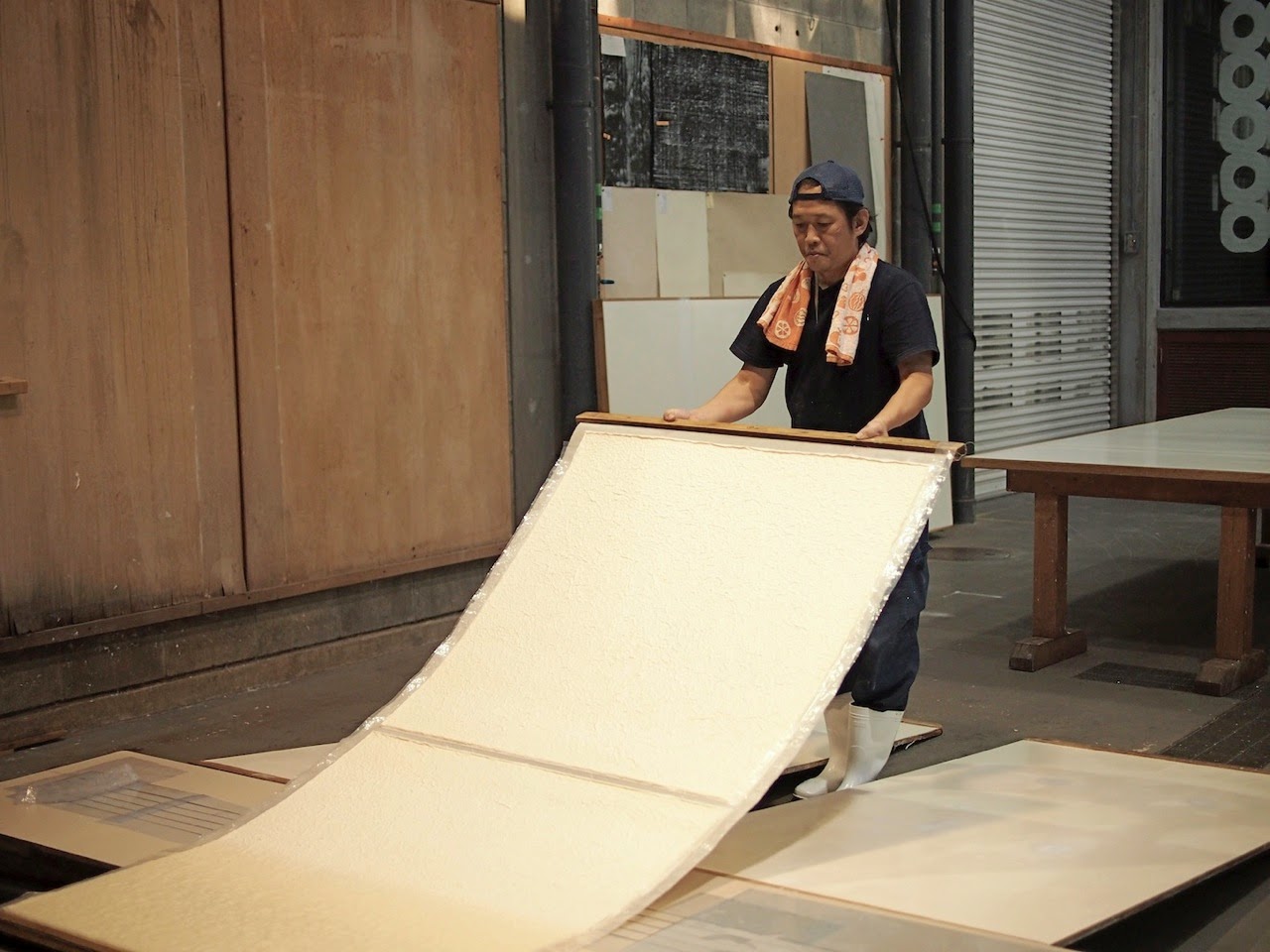
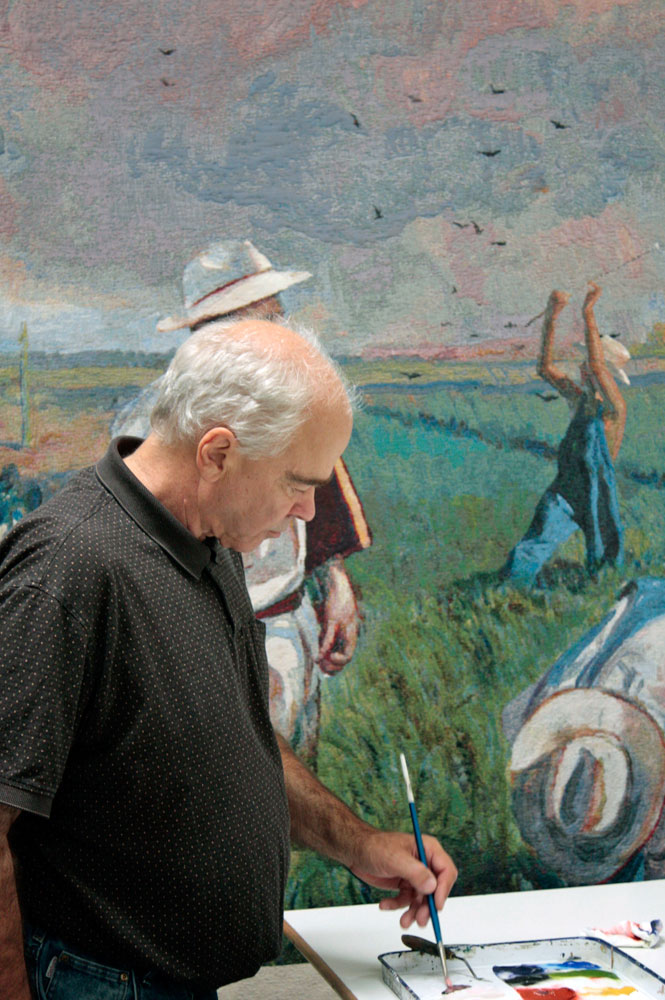
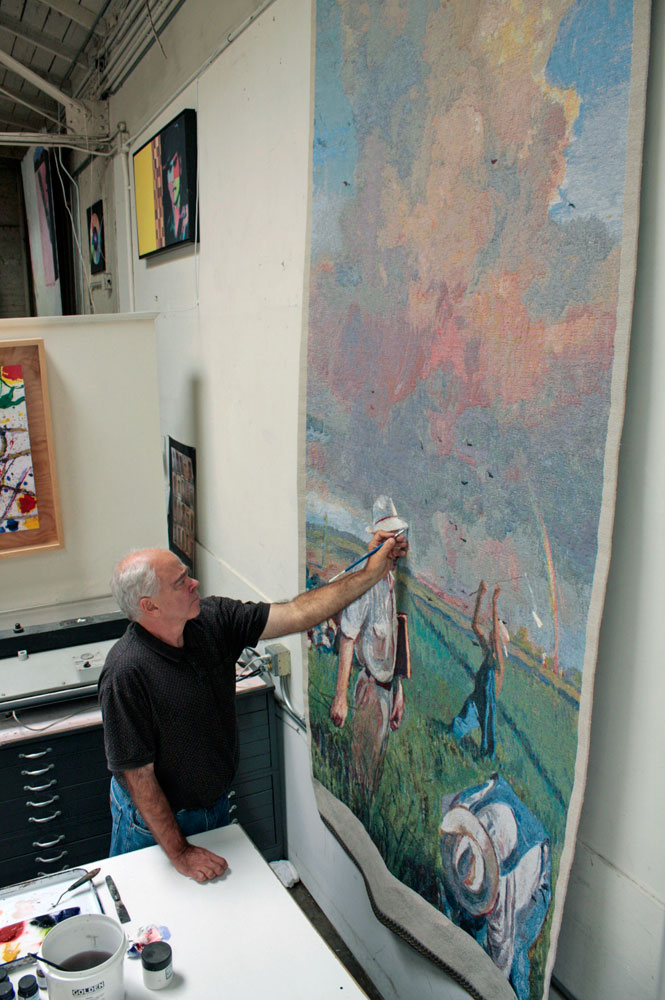
However, there are some projects we can show you: Guy Diehl proofed a new mixed-media edition, John Collier flew in from Texas to add some hand-painted details to his tapestries for the World Food Project, and David Kimball made some handmade paper in the increasingly renovated handmade paper mill! (The paper mill's condition continues to improve thanks to the hard work of Magnolia employees Ken Jensen and Brian Caraway.)

Brian Caraway and Don Farnsworth putting up the Collier tapestries

Brian Caraway and Don Farnsworth putting up the Collier tapestries

Shirley and John Collier

John Collier

John Collier

John Collier

Guy Diehl prints acrylic color on a copper plate etching

Guy Diehl and Nicholas Price discuss proofs

Guy Diehl examines a proof

David Kimball and Nicholas Price in the handmade paper studio

David Kimball making paper

David Kimball making paper