Wednesday, February 20, 2013

Pres. Obama signs new Chuck Close editions


Era Farnsworth in the White House Map Room with Chuck Close's tapestry Obama 2012 (II), waiting for the president to arrive. Photo by Donald Farnsworth.

Magnolia directors Donald and Era Farnsworth traveled to the White House recently to oversee the signing by Chuck Close and President Barack Obama of Close's recent print and tapestry portraits of the president. These editions, published by Magnolia Editions, were sold to raise funds for the president's re-election effort. Only official White House photographers are allowed to take pictures of the president in the White House, but Era Farnsworth sent these images and a first-hand account of signing prints with the nation's leader:

Hi friends and family,

It turns out there were no national emergencies and our meeting at the White House with Chuck Close and President Obama went extremely well.

We were picked up by Chuck, Sienna and Chuck's nurse at our meeting place, the Willard Hotel. Then we drove across the street to the White House, where we had to pass thru about 5 different security gates. At the first gate, Chuck's nurse was turned away: she couldn't even drive the van onto the grounds since she had not been previously cleared. So Sienna took over and we drove to the next gate, which was maybe 10 yards further. There a guard came out with a German Shepherd and walked a rotation around the van, the Shepherd sniffing it from all angles.


Chuck Close passing in front of the Treasury Department and one of the gates. (It's really cold in Washington!)

We passed the dog test and another gate slid down into the road, allowing us to drive through. At that point we were able to park with a number of other vans and SUVs, some of them with Obama stickers. We got out of the van into the DC cold, where we waited patiently at another gate while the guards checked our credentials once more. We walked down a path next to the Treasury Department and turned into another guardhouse, which then, after more checking of papers, scanning, etc, led directly into the White House.


Chuck and Meaghan, one of the people running the re-election fundraiser campaign, in a beautiful waiting room.


"Our" room is ready ("The Map Room").


Sienna, Chuck's partner, is an excellent photographer and talented artist. We were told in emphatic terms that we were not allowed to photograph the president in the White House.


After unpacking we had a bit of a wait until the great man arrived.


Don enthroned in a replica of a chair once owned by George Washington. They had some of the original chairs in the room; same red damask, slightly faded.


Manny, Chuck's right-hand man, and Chuck. Beth, Chuck's other irreplaceable assistant, had to hold down the fort in NY and could not be with us at the White House.

After a couple of false alarms ("We have movement; he's on his way" -- it turns out he was moving somewhere else), Obama walked into the room with a few secret service agents. Famous big smile, he seemed like an old friend. He greeted Chuck, whom he knows, and came over to me. I told him that we were from Oakland. He replied, "I love Oakland." Good response, but I bet he says that to all the home towns. I said everybody in Oakland and all of the artists, when I told them I might be meeting the president, said, "Give him a hug from me. We love Obama." He said, "Well, you better give me a hug, then." So I hugged Obama from all of you (in my mind, everybody who is receiving this update) and he hugged me back. Awesome!

He very efficiently signed all the prints he was supposed to sign and all of the tapestry labels. He made a couple cracks about the new Treasury Secretary Jack Lew's signature and said Lew is going to have to do something about changing it. Obama has a great signature, by the way, and so does Chuck, so the signatures look wonderful on the prints and on the labels. They don't devalue them, as Obama has joked Jack Lew's signature might do to the currency.

Generally, a respectful silence was maintained while Obama was signing. It's difficult for anyone to try to field questions and carry on a conversation while signing a number of pieces which have to be signed perfectly. It was so tempting to pull out an iPhone and snap a photo. Too bad it makes that ostentatious clicking sound. 

After signing, I did manage to tell him that we drive a Volt which we power with solar panels. And Don mentioned that we have not filled up in over 2,500 miles, which is true. In fact, we have not filled up that car yet. I thanked him for the federal tax credits. He seemed pleased. Don told him that the artists loved him. Manny got a hug, too; something about his grandmother wanting to give Obama a hug. Apparently, this is the path to an Obama hug. Actually, Manny's grandmother wanted him to give Obama a hug and a kiss. Obama said he'd hug him, but declined the kiss. And that was it; he was out the door to his next important meeting or task. We found him to be absolutely charming. 


Didn't manage to get a photo of Don with Obama, but did get one of Don cuddling up to Bo, the family dog. This photo was taken right after Bo had been licking Don's face. So Don must have some Obama family DNA now.

We may get some photos from the official photographer. If so, we will certainly share them!

Love from DC,

Era and Don

Previously: Chuck Close Obama tapestries in the news

Prints and tapestries by Chuck Close from Magnolia Editions

Artwork by Donald and Era Farnsworth from Magnolia Editions

Friday, February 15, 2013

Hung Liu at Mills College Art Museum

Hung Liu in front of Music of the Great Earth II, a mixed-media mural with elements printed at Magnolia Editions, at Mills College Art Museum. Photo by Doug Duran/SJ Mercury News staff

Hung Liu's "Offerings" will be on display at the Mills College Art Museum in Oakland through March 17, 2013. The show is a companion to Liu's upcoming retrospective at the Oakland Museum of California (opening March 15, 2013) and features several large-scale installation works, including Old Gold Mountain (1994), a mound of 200,000 fortune cookies atop a crossroads of railroad tracks.


Jiu Jin Shan (Old Gold Mountain) by Hung Liu at Mills College Art Museum. Photo by Doug Duran/SJ Mercury News staff

The back room is devoted to Liu's installation of antique Chinese dou (food containers), Tai Cang (Great Granary), as well as a large-scale mixed-media mural and a suite of prints, both created by Liu at Magnolia Editions.

Hung Liu - Music of the Great Earth VI, 2008.
Pigmented inkjet on paper, 18 x 90 in. Edition of 20

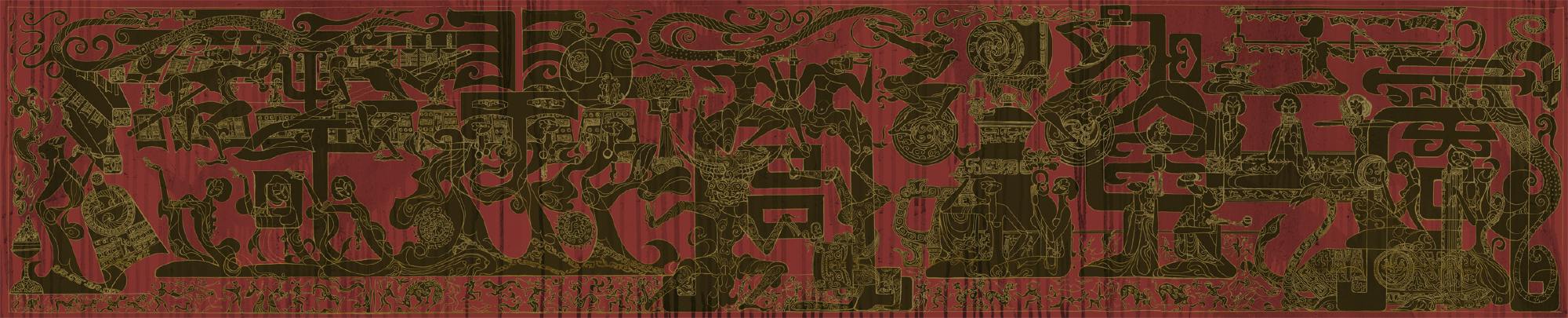
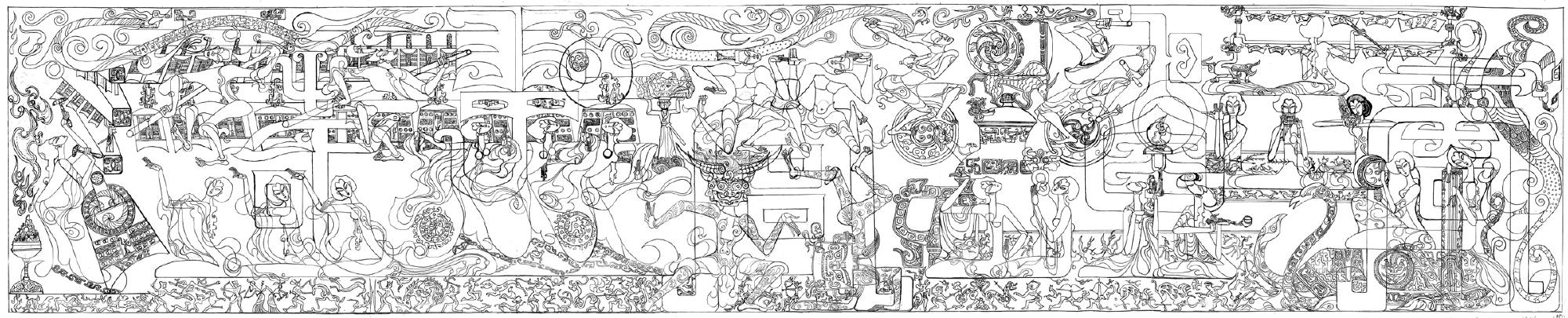
The mural seen at Mills was originally realized in 1981 as Music of the Great Earth, a 50 foot wide painting in the Foreign Students' Dining Hall at the Central Academy of Fine Arts in Beijing, where Liu received her graduate degree. In 1978, the artist had attended an exhibition in Beijing featuring centuries-old musical instruments unearthed in a recent excavation in the Hu Bei province. In a 2,400 year old tomb, archaeologists had discovered a 125-piece orchestra and 25 musicians. The ensemble of Chinese string, wind, and percussion instruments on display included a set of Bian Zhong bells (visible toward the left hand side of Liu's composition) ranging in size from eight inches to five feet tall; the set of bells is so enormous that players must stand and strike them with large mallets. Liu’s studies and drawings of the Hu Bei instruments became the basis for Music of the Great Earth.

In 1993, when Liu revisited China, she found that the former Dining Hall had been relegated to storage space; her mural, neglected for years, sat silently behind stacks of chairs and tables. In later years, Liu was told that it had finally been destroyed.

Hung Liu - Music of the Great Earth III, 2008.
Pigmented inkjet on paper, 18 x 90 in. Edition of 20

Liu used the large-scale printer at Magnolia Editions to create a new mural based on her earlier design, Music of the Great Earth II, which she further layered with hand-painted, autobiographical elements. She also printed a series of smaller Variations, which introduce new passages of color, texture, and figuration to her 1981 composition, on Hahnemuhle cotton rag paper at Magnolia Editions in 2008. Music...II and all of the Variations series are included in "Offerings."

We highly recommend experiencing this show by Liu, hailed as "America's most important Chinese artist" and one of our favorite people!

Hung Liu - Music of the Great Earth Line Drawing, 2008.
Pigmented inkjet on paper, 18 x 90 in. Edition of 20

Mills College Art Museum visiting hours and information

More art by Hung Liu from Magnolia Editions

Wednesday, February 6, 2013

Honoring David Kimball

David Kimball in the Magnolia Editions paper mill

Magnolia Editions co-founder David C. Kimball retires this year, after more than thirty years of sharing his expertise in the field of handmade paper with artists and artisans in the Bay Area community and beyond. 

A graduate of UCLA's Classics department with a Master's degree in Comparative Literature from San Francisco State, David entered the Ph. D. program in Comp Lit at the University of Oregon in the 1970s but was lured away by a young Bay Area papermaking enthusiast named Donald Farnsworth. Much like the 'patron saint of papermaking,' Dard Hunter, David's interest in paper grew out of his interest in books; initially, he recalls, he thought his experiments with paper might lead him to the field of letterpress printing or the production of literary broadsides.

Instead, he ended up co-founding Magnolia Editions in 1981 with Farnsworth and Arne Hiersoux, subsequently overseeing the studio's handmade paper mill as it relocated from its initial location in Kensington to the West Oakland warehouse location it occupies today. In the process, David became a behind-the-scenes collaborator on countless works of modern art. Many of Magnolia's early print editions either incorporated or were printed on handmade paper, such as Squeak Carnwath's Hand in Light lithograph series, which found Carnwath creating a unique effect by 'drawing' with raw paper pulp. Over the years, David created paper for editions by artists including Robert Arneson, Peter Voulkos, Joseph Goldyne, and Alan Magee; working with Farnsworth, he once used an eight-foot-long paper mold to create an enormous scroll of handmade paper for an ambitious print project by Judy Chicago


David Kimball gives a papermaking demonstration (video)

Magnolia has gained a reputation as a valuable source of papermaking supplies and knowledge, due in no small part to David's authority in the field. Recognized as a master papermaker, David has held demonstrations and classes for students and tour groups from all over the world at Magnolia's paper mill. Harlan Crowder's flickr features this photo set of a Magnolia Editions tour that includes several step-by-step shots of David demonstrating the papermaking process.

He has also hosted innovative programs such as the Combat Paper Project, which found Gulf War veterans recycling scraps of their combat uniforms into handmade paper. Meanwhile, he has been a valuable member of the handmade paper community at large, actively working to support the nonprofit magazine Hand Papermaking and at one point serving as its chairman of the board.

David Kimball and Robert Bechtle at Magnolia in 1982

David says the most rewarding part of his years at Magnolia has been the opportunity to create the substrate for a print or art piece -- to be a part of a team, serving a collaborator in the creation of a work of art. "It feels good," he says, "to know that I contributed even in a small way to, for example, Robert Bechtle's lithographs," popular editions on handmade paper which have long since sold out. He remains active in the handmade paper community and points to papermaker Timothy Barrett's recent MacArthur Fellowship as evidence of the medium's continued vitality. 

Kimball making paper at Magnolia in 2011

The staff at Magnolia Editions is proud and fortunate to have benefited from David Kimball's expertise, and we wish him the very best in his future endeavors.

Friday, February 1, 2013

Opening: Donald & Era Farnsworth at Red Barn Gallery

Bob Yogura is moved by 3-D prints by Donald and Era Farnsworth

Donald and Era Farnsworth's Specimens & Glass Houses recently opened at the Red Barn Gallery at the Pt. Reyes National Seashore Visitors Center in Pt. Reyes, California.

The glass houses of the exhibition's title refer to diatoms, single-cell organisms found in nearly every body of water on Earth that build delicate shells for themselves out of silica. Diatoms are major sources of oxygen in our atmosphere and are estimated to be responsible for 25% of the carbon fixation (conversion of carbon dioxide to organic compounds) in the ocean.

William Wiley with Donald and Era Farnsworth

By enlarging these microscopic life forms and rendering them using an eye-catching, stereoscopic 3-D process, the Farnsworths invite us to consider both the beauty and the ecological importance of these otherwise invisible creatures.

Mildred Howard, Margo Hackett, Bob Yogura and others enjoy the Farnsworth's 3-D prints

Specimens & Glass Houses runs from January 25 through April 1, 2013. Please visit the Pt. Reyes National Seashore website for visiting information.

William Wiley, Donald Farnsworth, and Hung Liu

Mary Webster with 3-D prints by the Farnsworths

Mary Webster, Barbi Anne Reed, William Wiley, Donald & Era Farnsworth (photo by Dallas Saunders)

Donald Farnsworth and Kevin Rowell with the irresistible Hung Liu (photo by Dallas Saunders)

More art by Donald & Era Farnsworth at Magnolia Editions

Friday, December 14, 2012

New Projects: Innovative Surfaces

Test print of Chuck Close's Cindy (2012) on marble. Photo by Donald Farnsworth

Nearly every day at Magnolia Editions brings a new creative question or discovery: among the completed editions and framed work from the past, visitors to the studio can always find artifacts and examples of techniques that are still being refined -- or in some cases, were invented only a few hours ago! This post will highlight some of the works-in-progress currently underway at Magnolia, ranging from early experimental tests to forthcoming editions that just need the last few finishing touches.

While these projects span a variety of media and involve the unique imagery of very different artists, they have one thing in common: an exploration of issues of surface and texture, informed as much by the traditions of sculpture, ceramics, textiles, and collage as by the more traditional printmaking paradigm in which very flat layers of ink and pigments are layered on a flat paper ground. In Magnolia's latest experiments, lessons learned from decades of printmaking inform a variety of innovative approaches to surface: in each these projects, the possibilities of texture and surface are just as much a part of what makes the work interesting as the colors and forms depicted.

Close-up view of print on marble

This emphasis on surface is significant at Magnolia, where digital techniques and acrylic inkjet printing play such a large role in the studio's production of art. It signals that although a work might originate as a digital file -- whether digitized from a hand painted image or created entirely by manipulating pixels on a screen -- the ultimate production of that work must not only consider but prioritize its surface and texture. Put another way, the art is not just the bits and bytes seen on a computer screen, but the physical object created from that file; instead of trying to replicate the flatness and ethereal aspect of encountering an image on an LCD display, many artists at Magnolia are finding ways to bring those same images to life by using three-dimensional surfaces that reflect the rich variety of sensual, tactile, and unpredictable textures found in the world all around us.

New work on panel by Squeak Carnwath

For Squeak Carnwath, the self-declared "painting chauvinist" for whom oil painting remains "queen of the arts," Magnolia has worked to develop a technique that allows Carnwath to create editioned multiples which fall under the rubric of printmaking while still retaining the layered physicality and impasto of a painting on canvas. Carnwath and Magnolia director Donald Farnsworth first explored this particular technique in 2009, the year of Carnwath's retrospective at the Oakland Museum; the artist used this method to create three unusual mixed-media editions on panel for that show, and continued to experiment with it in her artist's book, Philosophy, published by Magnolia in 2010. In a letter to poet John Yau, Farnsworth wrote of the book, "We are moving into strange and dangerous territory – printmaking that may raise some eyebrows... making textures that were, before this, the private playground of painting and sculpture." The technique involves building up layers of hand-brushed marble dust and gesso on a birch panel (or, in Philosophy, on Arches cotton rag paper). Carnwath distributes these layers according to the lines and objects depicted in each of her compositions, which are then printed onto the textured surface using acrylic ink; the prints are carefully registered on a flatbed printer so as to precisely align with the minute topographical variations of the modeling paste.

New work on panel by Squeak Carnwath

In Carnwath's latest works in progress, she delights in using this technique to conflate textures that are printed, painted, sculpted and limned; Carnwath says that this method resonates with the work of American trompe-l'oeil artists John Frederick Peto and William Harnett, and with the paintings of her favorite artist, Rembrandt, in which objects are three-dimensionally sculpted from layers of thickly applied paint. "There's illusion [in their work]," she says, "but there's also a kind of literalness," adding: "I like these kinds of experiments or loose objects that aren't painting – that are an extension of it."

From Carnwath's mixed media prints, which are nearing completion, we turn to a project still in its infancy: recently, Farnsworth and the Magnolia staff have begun experimenting with using a combination of UV-cured acrylic printing and the OSHA-approved clear coat process used in the automotive industry to generate stunning and hopefully long-lasting imagery on marble. Using a digital file from Chuck Close's recent series of watercolor prints, Magnolia has conducted a series of promising tests in which each individual square in Close's signature grid is printed in acrylic on a small tile of Carrara marble and then sent to a nearby auto shop for clear coating for maximum durability and a brilliantly glossy finish. Relative to the understated, matte watercolor prints on paper, these tests possess an extraordinary vibrancy and physicality.

Close-up view of print on marble

Because the watercolor images are generated by layering hand-painted marks from four independent channels of color information, the edges of each layered mark don't line up exactly, creating a rather beautiful halo effect that hangs slightly over the edge of each tile: each unit thus becomes its own tiny abstract painting, in which the effect of gravity on the pigments as they are printed -- what Farnsworth likes to call "the hand of Nature" -- becomes part of the work. Marble is particularly appropriate for Close, who has noted in interviews the kinship between his process and the ancient marble floor mosaics he saw while living in Rome, and who is currently working with Magnolia to develop a series of twelve large mosaics for the East 86th St. subway station in Manhattan. Having frozen and boiled the printed marble tiles with no apparent change in color or consistency, Farnsworth and the staff at Magnolia are optimistic about this technique's eventual viability for durable, long-lasting public art projects.

Proof of Guide, a new tapestry edition by Kiki Smith

Speaking of durable, long-lasting media, Magnolia continues to break ground in the field of tapestry weaving. The latest tapestry editions from Kiki Smith (now in the final proofing stages) are particularly notable for their translation of various kinds of collaged material, from crumpled handmade paper to glitter and metallics, and handmade marks suggesting a variety of natural textures -- fur, feathers, bark, skin, even the scales of a snake -- into warp and weft threads.

Detail from a proof of another new tapestry by Kiki Smith

One of the most striking aspects of these editions is their attention to surface, and the tension between the heterogenous array of textures depicted and the fact that they are all represented by a common textile medium with its own intrinsic tactility and texture. To the viewer of these tapestries, somehow the feathers feel like feathers and the fur 'reads' as fur -- even though if one were actually allowed to reach out and touch the work, they would of course simply feel like woven wool. Here again, the surface of the work emerges as an indispensible part of what makes it so compelling, as the central theme of the work -- a celebration of the diversity of flora and fauna -- is directly linked to the diverse textures of its surface.

Detail from test of hikkake papermaking technique from Magnolia Editions' paper mill

Finally, we look at a technique so new that it is still somewhat secret; as such, we can currently offer only a brief preview of the tests to date. Magnolia has been taking advantage of its in-house paper mill to experiment with hikkake as a fine art technique. Hikkake is a technique practiced by very few papermakers (cursory research indicates less than a handful of practitioners, all in Japan) in which a layer of wet, freshly made paper is layered onto another piece of different-colored, freshly made paper to produce a pattern or image. As noted, we are limited in how much we can disclose as to the direction of the experiments at this time, but for now we can show you these handsome details from recent tests. Here, too, the surface becomes key to our experience of the work: the interaction of the two layers of paper pulp generates unique, dimensional textures which are as much a part of the work's appeal as the imagery depicted.

Detail from another hikkake test

In an essay on Carnwath's work, Karen Tsujimoto compares her methods to those of Rembrandt, noting that "in [Rembrandt's] hands, paint – the substance itself – became something real, and in the process, he was able to convey the idea that vision is a kind of touch." Magnolia's new projects similarly bridge the optic and the haptic, bringing an exciting dimensionality to the printmaking tradition and, as always, breaking down barriers between media in an effort to provide artists access to undiscovered modes of expression.

Wednesday, November 28, 2012

New Hung Liu editions

Hung Liu - Madame Shoemaker, 2012. Jacquard tapestry, 56 x 72 in. Edition of 12.

Chinese history has always been the essence of Hung Liu’s work: raised in Beijing during Mao’s Great Leap Forward and trained in the Social Realist tradition, Liu now uses painting as a means to reanimate historical photographs. “I hope to wash the subject of its exotic ‘otherness,’” she writes, “and reveal it as a dignified, even mythic figure.” Liu’s tapestry Madame Shoemaker finds the exalted and the serene in a forgotten moment from the first half of the 20th century, revealing the beauty and heroism in the labors of an anonymous woman from China’s past.

Like many of Liu’s works, this tapestry edition is based on a painting which was in turn based on a historical photograph: in this case, a scene of women from a village in the Chinese countryside, who made shoes, clothing, and other supplies for anti-Japanese fighters during the second World War. For Madame Shoemaker, Liu singled out one of the women, finding a personal connection: “Making shoes for your family is a Chinese tradition,” explains Liu, “my grandmother made shoes for me when I was young: I remember watching her slowly make each part by hand from a tough, strong hemp and sewing them together, little by little.” The artist likens this activity both to a meditative state and to the practice of making art in general: putting time in day by day, slowly accumulating work to see a project through to completion. The woman depicted thus becomes an avatar both for Liu herself and for the universal power of feminine creativity and strength.

The tapestry’s title, explains Liu, was inspired by the butterflies surrounding the figure; these colorful creatures are based on traditional Chinese paintings of butterflies on silk from the 10th and 12th centuries, and reminded the artist of the opera “Madame Butterfly.” However, Liu is quick to point out that her Madame is “more blue collar, stronger and happier” than that opera’s helpless, tragic heroine. She is demure, but no less strong and significant than the soldiers who will receive the shoes she makes: “It’s important to remember when looking back at the war,” says Liu, “that there was not just a ‘band of brothers’ but also a whole band of sisters standing behind them.”

Hung Liu - The Lifter, 2012. Woodcut with acrylic, 23.25 x 34.75 in. Edition of 25.

Magnolia also recently published two editions of woodcut prints with acrylic, The Lifter and The Reader, which may initially surprise Liu enthusiasts with their unusual line quality and pictorial simplicity but which deserve a closer look: there is more going on than first meets the eye. Liu based these innovative works on imagery from illustrated patriotic stories in the xiaorenshu, or Chinese picture books, that she read as a child and which she likens to the Dick and Jane primers supplied to American children in the 1950s.

Hung Liu - The Reader, 2012. Woodcut with acrylic, 23.25 x 34.75 in. Edition of 25.

Exhibited as part of Liu's "Happy and Gay" show at Rena Bransten Gallery in San Francisco, the imagery in these prints is "at once charming and eerie," says the exhibition's press release: "Seen from an historical perspective, the propaganda angle strongly supplants the fable or entertainment factor." Incorporating her extraordinary sense of color and signature brushwork via layers of printed acrylic, Liu adds a dimension of historical inquiry and bittersweet, even ironic reflection to the crisp woodcut lines and straightforward, storybook imagery of the xiaorenshu: these works "can be understood, in part, as homage to all the artists who lost their art to propaganda during China's revolutionary epoch."

Liu's exhibition "Happy and Gay" is on view at Rena Bransten Gallery through January 12, 2013.

Press release for Madame Shoemaker (PDF, 408Kb)

More art by Hung Liu at Magnolia Editions

Tuesday, October 16, 2012

Chuck Close at Pace Gallery

Press Release - PDF (831kb)

NEW YORK, October 5, 2012— Pace is honored to present an exhibition of recent paintings, prints, and tapestries by Chuck Close. Close has been represented by Pace since 1977. The exhibition will be on view from October 19 through December 22, 2012 at 534 West 25th Street. An opening reception will be held on Thursday, October 18th from 6 to 8 p.m. A full-color illustrated catalogue with an introductory essay by Robert Storr will accompany the exhibition.

For more than five decades, Close has captured his friends and family in portraits that are as abstract as they are realistic, executed in a diverse range of media and techniques. The vehicles for Close’s mark-making range from oil paint, airbrush, and finger printing, to paper pulp, colored pencil, and photography—including the Daguerreotype, which, like the artist’s jacquard tapestries, revived a centuries-old-tradition, propelling an antiquated technique into the modern era. This exhibition will include the first presentation of Close’s newest experiment with technology: watercolor prints. “Invention,” Storr writes, “plays a pivotal part in the fundamental dynamics of Close’s work but not in the sense of contriving an unprecedented pictorial or conceptual model. Instead his pragmatism or, better said, innovative empiricism, is aimed at devising previously untested ways of filtering and organizing the data he observes in nature, initially captures photographically, and seeks to transpose by other means onto a two-dimensional surface.”

Highlights of the exhibition, Close’s first gallery show in New York since his 2009 exhibition at Pace, include never-before-seen paintings of Cindy [Sherman], 2012 and Phil [Glass], 2011-2012. Phil, which stretches over 9 feet tall and 7 feet wide, is the artist’s most recent iteration of his close friend, who he has captured in numerous media since 1969, when the now famed composer was working as a studio assistant to Close’s classmate from Yale, Richard Serra. Cindy, the artist’s newest oil painting, is also the most recent portrait that Close has created of the artist since he first painted her in 1988. Two sets of Self-Portrait triptychs—one larger at 72 x 60 inches and another more intimate series at 36 x 30 inches, will be presented in their entirety for the first time.

This exhibition will also be the East Coast debut of the artist’s recent paintings of Kara [Walker], 2010, Laurie [Anderson], 2011, Aggie [Gund], 2011, and the musician Paul [Simon], 2011, as well as tapestries of Lou [Reed], 2012, Lucas [Samaras], 2011 and Roy [Lichtenstein], 2011. This exhibition will also feature Close’s new watercolor prints, the artist’s first in-depth experimentation with the possibilities of digital technology. Close uses approximately 14,500 of his own, hand-made watercolor marks, individually scanned into the computer, as the vocabulary for these works. Fully immersed in every aspect of the complex process, Close organizes each image, determining how to break the composition down, the number of squares over which it will fall, and the order and exact location that each individual mark will be applied. The artist prints the works in watercolor on watercolor paper in layers of magenta, cyan, and yellow, never repeating a mark more than six times in each print. Storr writes, Close’s criterion for judging a process is not whether it achieves a preordained goal efficiently, but rather whether it significantly alters and enriches the ways we see an image we thought we knew from exposure to it in other incarnations. Accordingly, Close’s decision to set computers to the task of making watercolors was, after some trial and error, dictated by the particular effects that became manifest while deploying them, and most especially the manner in which computers enhanced the medium-specific qualities of watercolor instead of their own data-digesting capacities.

Chuck Close (b. 1940, Monroe, Washington) has been the subject of over 200 solo exhibitions in more than 20 countries, including major exhibitions at New York’s Museum of Modern Art, The Metropolitan Museum of Art, the Museo Nacional Centro de Arte Reina Sofia in Madrid, and most recently, at the State Hermitage Museum in St. Petersburg, Russia. Close has also participated in nearly 800 group exhibitions. A survey devoted to the artist’s innovative printmaking techniques, entitled Chuck Close Prints: Process and Collaboration, will have travelled to eighteen venues, five countries and three continents by October of 2013, when it reaches the final venue of its ten year run at the Moderne Salzburg, MdM Mönchsbert in Austria as Chuck Close: Multiple Portraits (October 27 through February 17, 2013). Another exhibition devoted to the artist’s prints will be on view at Monterey Museum of Art, California from October 27, 2012 through February 17, 2013. 

An award-winning artist, Mr. Close was presented with the prestigious National Medal of Arts by President Clinton in 2000. In 1988 Mr. Close was paralyzed following a rare spinal artery collapse. He continues to paint using a brush-holding device strapped to his wrist and forearm. Mr. Close studied at the University of Washington School of Art (B.A., 1962) and at the Yale University School of Art and Architecture (B.F.A., 1963; M.F.A., 1964), receiving honorary degrees from both of his alma maters as well as 20 other institutions. Close is a member of the American Academy of Arts and Letters, has served on the board of many arts organizations and was recently appointed by President Obama to serve on The President’s Committee on the Arts and the Humanities. The artist, who painted President Clinton in, 2006, also recently photographed President Obama.

For contact information, please consult the PDF linked above or visit Pace's website.