Wednesday, October 5, 2011

Rupert Garcia at MOCA LA

Rupert Garcia - photo by Juan Garza

Here's Rupert Garcia with some of his silkscreen work at the Geffen Contemporary, MOCA LA. Garcia is included in their current exhibition, "Under the Big Black Sun: California Art, 1974-1981."

Monday, October 3, 2011

McLuhan on mixed-media

"It is the poets and painters who react instantly to a new medium like radio or TV. Radio and gramophone and tape recorder gave us back the poet's voice as an important dimension of the poetic experience. Words became a kind of painting with light, again. But TV, with its deep-participation mode, caused young poets suddenly to present their poems in cafes, in public parks, anywhere. After TV, they suddenly felt the need for personal contact with their public...

In our age artists are able to mix their media diet as easily as their book diet... Eliot made a great impact by the careful use of jazz and film form. The Love Song of J. Alfred Prufrock gets much of its power from an interpenetration of film form and jazz idiom... Prufrock uses not only film form but the film theme of Charlie Chaplin, as did James Joyce in Ulysses... And Chaplin, just as Chopin had adapted the pianoforte to the style of the ballet, hit upon the wondrous media mix of ballet and film in developing his Pavlovalike alternation of ecstacy and waddle. He adopted the classical steps of ballet to a movie mime that converged exactly the right blend of the lyric and the ironic that is found also in Prufrock and Ulysses. Artists in various fields are always the first to discover how to enable one medium to use or release the power of another.

The printed book had encouraged artists to reduce all forms of expression as much as possible to the single descriptive and narrative plane of the printed word. The advent of electric media released art from this straitjacket at once, creating the world of Paul Klee, Picasso, Braque, Eisenstein, the Marx Brothers, and James Joyce...

The hybrid or the meeting of two media is a moment of truth and revelation from which new form is born... The moment of the meeting of two media is a moment of freedom and release from the ordinary trance and numbness imposed by them on our senses."

- Marshall McLuhan, Understanding Media, 1964

Friday, September 23, 2011

Artists at the studio

In the past few weeks we've been working on several projects which are either too top-secret to show, or are still in the earliest stages.

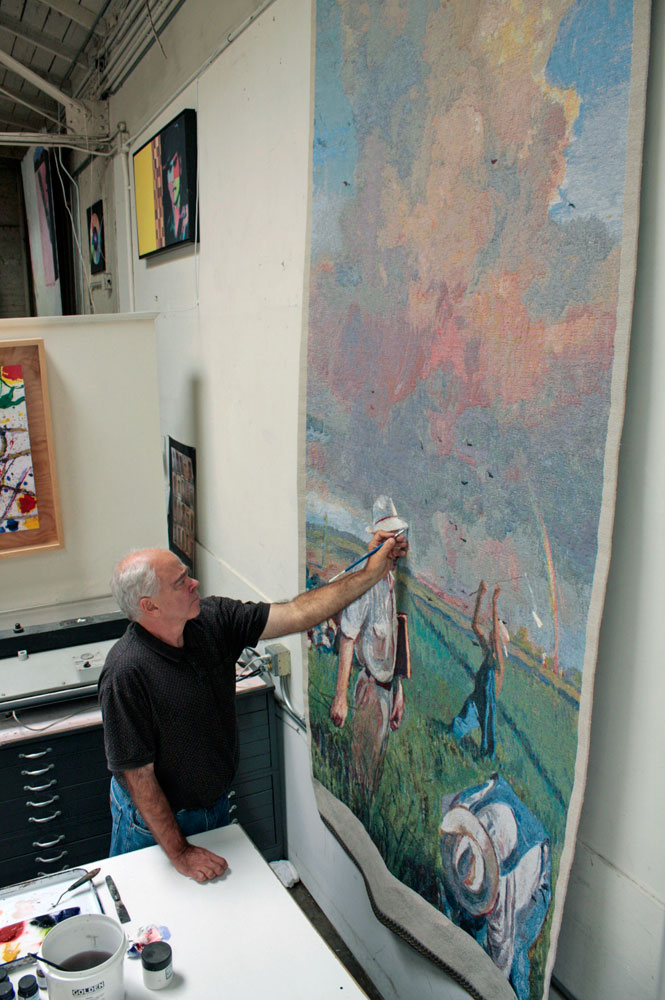
However, there are some projects we can show you: Guy Diehl proofed a new mixed-media edition, John Collier flew in from Texas to add some hand-painted details to his tapestries for the World Food Project, and David Kimball made some handmade paper in the increasingly renovated handmade paper mill! (The paper mill's condition continues to improve thanks to the hard work of Magnolia employees Ken Jensen and Brian Caraway.)

Brian Caraway and Don Farnsworth putting up the Collier tapestries

Brian Caraway and Don Farnsworth putting up the Collier tapestries

Shirley and John Collier

John Collier

John Collier

John Collier

Guy Diehl prints acrylic color on a copper plate etching

Guy Diehl and Nicholas Price discuss proofs

Guy Diehl examines a proof

David Kimball and Nicholas Price in the handmade paper studio

David Kimball making paper

David Kimball making paper

Friday, August 26, 2011

Rainmaker

Hung Liu - Rainmaker, 2011
Jacquard tapestry, 71 x 78 in. Edition of 12

Hung Liu's latest tapestry edition, Rainmaker, gracefully translates Liu's virtuosic washes and drips of oil paint into warp and weft threads.

In her paintings, Liu primarily uses 19th and 20th century photographs of Chinese laborers and courtesans, which she surrounds with a unique mixture of traditional Chinese symbols, calligraphic flourishes, and dripping veils of linseed oil. Liu’s husband, the writer and curator Jeff Kelley, describes her paintings as an alchemical marriage, in which “the fresh, luscious poetry of the “mineral period” (painting) presses against the dry atrophied plates of the “chemical period” (photography).

Hung Liu - Rainmaker (detail)

Liu’s tapestries, then, are the grandchildren of this marriage. Pixels containing the DNA of those paintings are ‘bred’ with the tapestry medium to produce a new hybrid, in which the singular texture and familiar physical presence of the “textile period” are infused with the precise values of the “digital period.” The photographs, whose authoritative gaze is literally disintegrated by the artist's strokes of oil, are practically lost; the ensuing compositions exist in a space somewhere between painting and textiles, pigment and threads. Her tapestries disavow an inherent truth in any one form of mark-making, weaving together diverse media to tell their dreamlike tales.

Hung Liu - Rainmaker (detail)

In keeping with its title, Liu's Rainmaker is resplendent with splashy, dripping trails of painted color; two dragonflies, Chinese symbols of summer, crown the head of its enigmatic, anonymous subject.

More art by Hung Liu from Magnolia Editions

Wednesday, August 24, 2011

Rob Keller, Amy Ernst, Squeak Carnwath, George Miyasaki at the studio

Rob Keller at Magnolia Editions

Artists Rob Keller and Amy Ernst worked on print projects at Magnolia today; Squeak Carnwath also stopped by with her dog Vermeer, and George Miyasaki pulled some collagraph proofs.

You may remember Keller's tapestry of mummified bees, which numbers among the earliest tapestry editions published by Magnolia. Keller continues to make art involving (or perhaps in collaboration with) his bees; his most recent series of prints depict an experiment in which he released a feral colony of bees into a Victorian dollhouse.

Art by Rob Keller: feral bees in a dollhouse!

Art by Rob Keller

Art by Rob Keller

Keller also created some bee-inspired wallpaper, printing directly on a specially coated roll of wallpaper from Magnolia's large-format inkjet printers:

Bee wallpaper by Rob Keller

Bee wallpaper by Rob Keller


Meanwhile New York-based artist Amy Ernst managed to miss the East Coast earthquake (and catch the West Coast quake!) by spending this week working at Magnolia with printer Tallulah Terryll.

Amy Ernst at Magnolia with one of her artist's books

This visit finds Ernst (granddaughter of famed Surrealist Max Ernst) incorporating more imagery printed on the flatbed acrylic printer and mixing media with great aplomb.

Ernst is using the flatbed printer to enlarge, modify, and re-work imagery from various sources, including an extraordinary artist's book she finished earlier this year:

Artist's book pages by Amy Ernst

Artist's book pages by Amy Ernst

Cover of artist's book by Amy Ernst

Detail of art in progress by Amy Ernst

Detail of art in progress by Amy Ernst

Art in progress by Amy Ernst


Squeak Carnwath also came by to make a poster for her upcoming show at Sylvia White Gallery.

Donald Farnsworth, Squeak Carnwath, and Carnwath's dog Vermeer


Amy Ernst and Carnwath's dog Vermeer quickly became friends:

Squeak Carnwath's dog Vermeer and Amy Ernst

Vermeer and Ernst


A delicious lunch of Salvadoran food followed, after which Keller and Carnwath returned to their respective studios.

Later, George Miyasaki arrived to proof one of his signature collagraph plates with printers Brian Caraway and Nicholas Price.

Brian Caraway (back to camera), Donald Farnsworth, George Miyasaki, Amy Ernst, and Tallulah Terryll


Miyasaki and Farnsworth consider Miyasaki's latest print (with a woodcut by Rupert Garcia in the background)

No, Miyasaki Dark is not a band name -- it's the special blend of ink for Miyasaki's collagraph plates

Caraway and Price pull a proof

Miyasaki and Caraway compare notes
Wednesday, August 10, 2011

Mystery photos

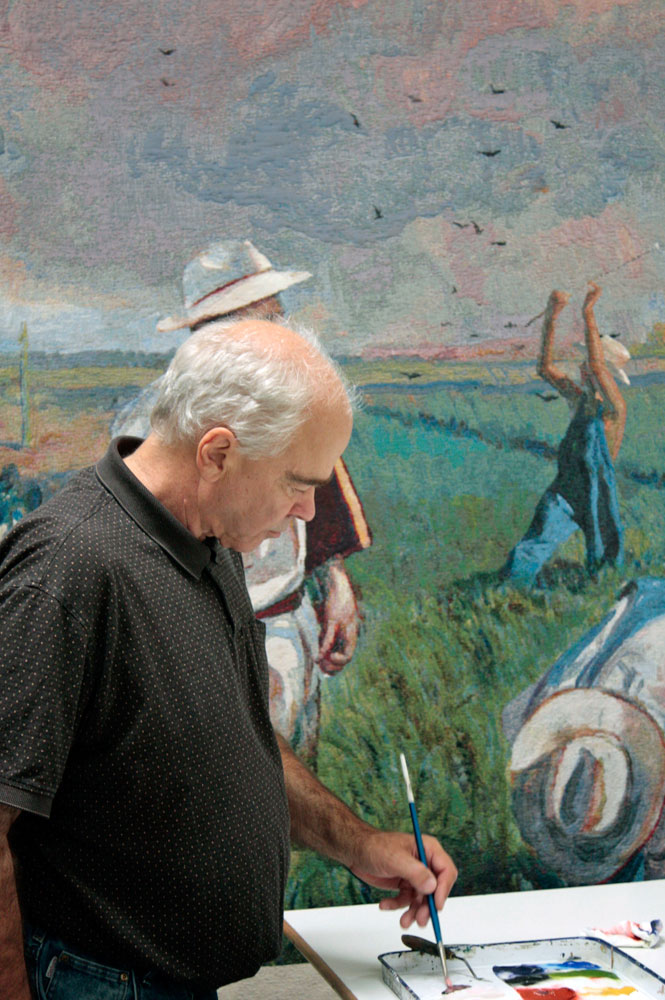
Printer Tallulah Terryll returned to the studio today from vacation and was wowed by a top secret project that Nicholas Price and Donald Farnsworth have been working on.

We can't tell you what it is, but Terryll did take these mysterious photos!


Can you guess what the media is?

Tuesday, August 2, 2011

Tsunami Relief Print Edition

Donald & Era Farnsworth - Sacred Pine, 2011
Pigmented inkjet print on rag paper; 27 x 20.75 in. Signed open edition.

Magnolia Editions' latest print edition is a fundraiser which will help nonprofits working to rebuild Japan and dismantle nuclear power plants on California's coast.

Donald & Era Farnsworth's Sacred Pine depicts a unique pine tree from one of the Japanese cities hit hardest by the tsunami; miraculously, this single tree was the only survivor from a grove of more than 70,000.

To learn more about the composition, purchasing this print, and how your modest donation can help both locally and globally, please see this Press Release on Magnolia's website.